
Plazer
Bots, webhooks and automations of the Plazer messenger that also work in end-to-end encrypted channels: a bot is a participant with its own keys there, not a hole in the encryption. Webhooks accept the popular embed format, "when X, do Y" rules are set up without code, and GitHub, Steam and Spotify accounts and bridges to other messengers are connected in settings.
Overview
Plazer is an encrypted messenger for communities: servers with channels, direct messages and voice rooms, with content encrypted end to end. A community that moves to it does not arrive empty-handed. It has bots for tickets and polls, webhooks from its repository, shop and monitoring, and rules that welcome newcomers and hand out roles.
All of that works in Plazer even where the conversation is encrypted. That was the core of the job: an integration must not become a back door to content the server is designed not to know.
A bot in an encrypted channel
In an end-to-end encrypted channel the server does not know the content. For a bot to read it, it has to be in the conversation just like people, with its own keys and on the list of those who hold them.
from the moment it is added it has keys to new messages, like someone who has just joined, and it cannot read the earlier history.
every integration that reads or writes in an encrypted channel stands on the list of people with keys.
once the bot is removed, the remaining participants agree on new keys, so it cannot read anything written afterwards.
Bot commands
Typing a slash brings up a list of commands with descriptions, and after you pick one the app tells you what to put in each field: a date, a channel, a person or plain text. A bot gets a role like any server member, sees only those channels and does only what its permissions allow, which can be changed at any time in server settings. Commands work in channels, in threads and in a direct chat with the bot.
Webhooks
A webhook is an address other services send messages to. A shop, a code repository or monitoring sends a short message, and Plazer drops it into the chosen channel, encrypted ones included, or straight into direct messages. There is no bot to write and no server to run: you copy the address and paste it into the service's settings.
Webhooks accept the popular message and embed format, so an existing integration is switched over by changing the address alone. The address is created and deleted in the channel settings, and whoever does not know it cannot send anything through it.
Automations without code
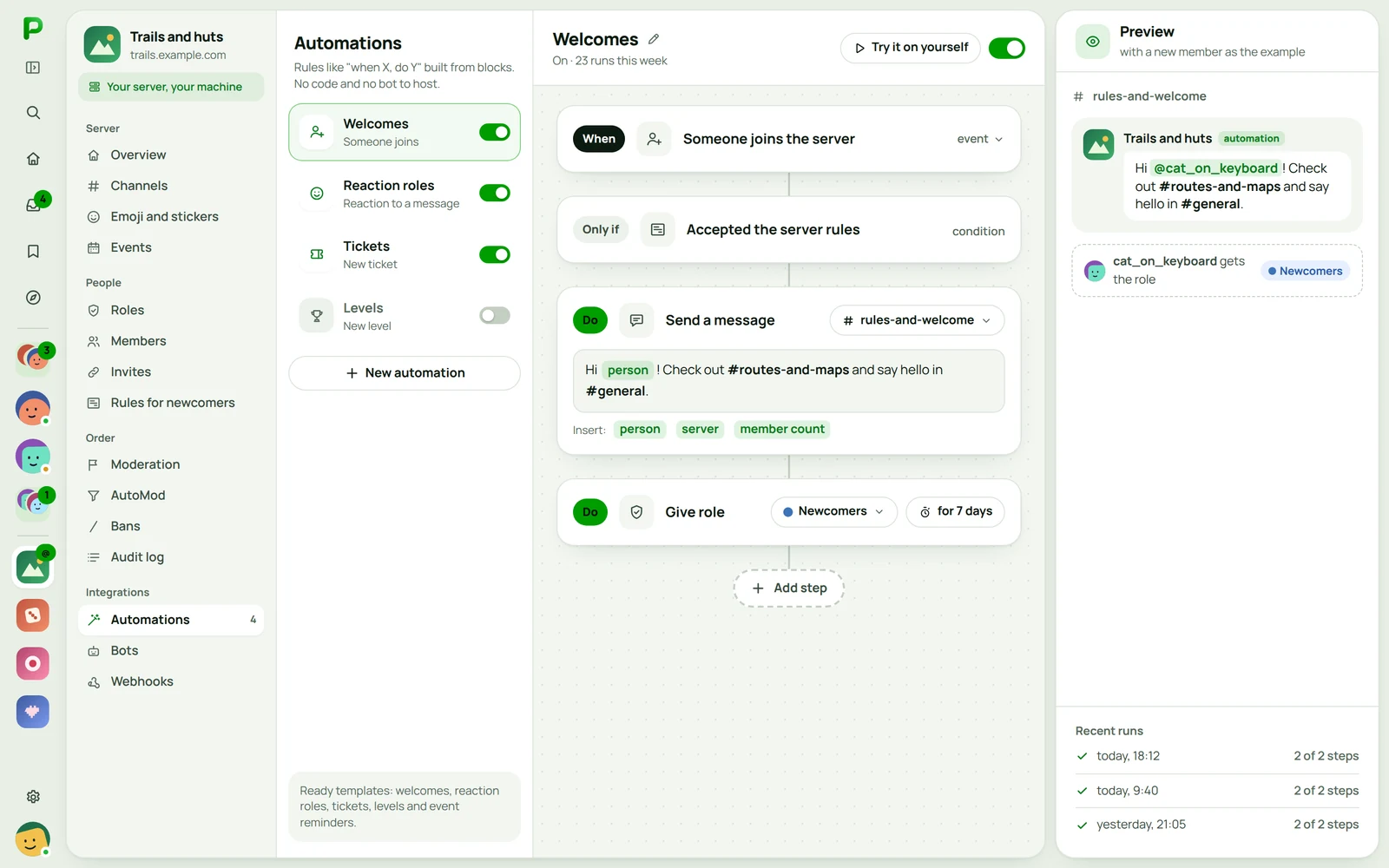
Most of what servers add bots for are simple "when X, do Y" rules. In Plazer they are put together from ready blocks in a separate tab of the server settings, next to roles, channels and moderation, and every rule has its own switch.
Ready rules
| When | Plazer does |
|---|---|
| Someone joins the server | Posts a welcome in the welcome channel and gives the newcomer role |
| Someone reacts under a role message | Gives the role tied to that reaction and removes it when the reaction goes |
| Someone opens a ticket | Creates a private thread with the moderators and pings their role |
| Someone reaches a new level | Gives the role for that level and announces the promotion in a channel |
A server also has its own economy and levels with an admin panel: a currency with a name and icon, the activities that count toward a level, the level curve and rewards at thresholds. Embeds and forms are built in the editor by any member, not just a bot, so sign-ups, recruitment and polls with open answers need no integration at all.
Connected accounts and bridges
GitHub, Steam, Spotify and other accounts are connected to a profile, so others see right away where to find you. Authorised apps are listed and disconnected in account settings.
A bridge links a Plazer channel with a conversation in another messenger and carries messages both ways. The community does not have to move in a single day, and those still on the other side stay in the conversation.
The bot API
When ready blocks are not enough, you write your own bot: with a token, API requests, an event gateway, its own registered commands and webhooks for messages from outside services. Plazer's code is open, so every server response can be checked at the source.
Questions about Plazer

More projects
More work from the same category - see how we tackle similar challenges.
Have a similar project?
Get in touch - a quote is free and comes back within an hour.