
Website and app maintenance after launch
We stay after launch: support included in the project, then hosting with monitoring, updates, backups and development on a subscription or on request. We tailor the maintenance plan to the project and quote it individually.
Support after acceptance
Support and monitoring after acceptance are included in the project price. How long they last depends on the size of the project, and the exact period goes into the order.
The year after final acceptance, one square a day
The darker a day, the more projects are still supported on it: the first 30 days every one, up to 90 the standard, beyond that only larger ones.
What maintenance covers
A maintenance plan is made of hosting with monitoring, updates, backups and small changes. We tailor it to the project and quote it individually.
Updates
We update libraries and dependencies and apply security fixes before an outdated version becomes a security hole.
Backups
We back up the data regularly and check that the backup restores before it is ever needed.
Monitoring
Pharos checks the site, the certificate and the backups, so we learn about an outage from an alert, not from your customers.
Small changes
Content tweaks, new fields and small features are done without a separate quote for each one.
What the monitoring checks
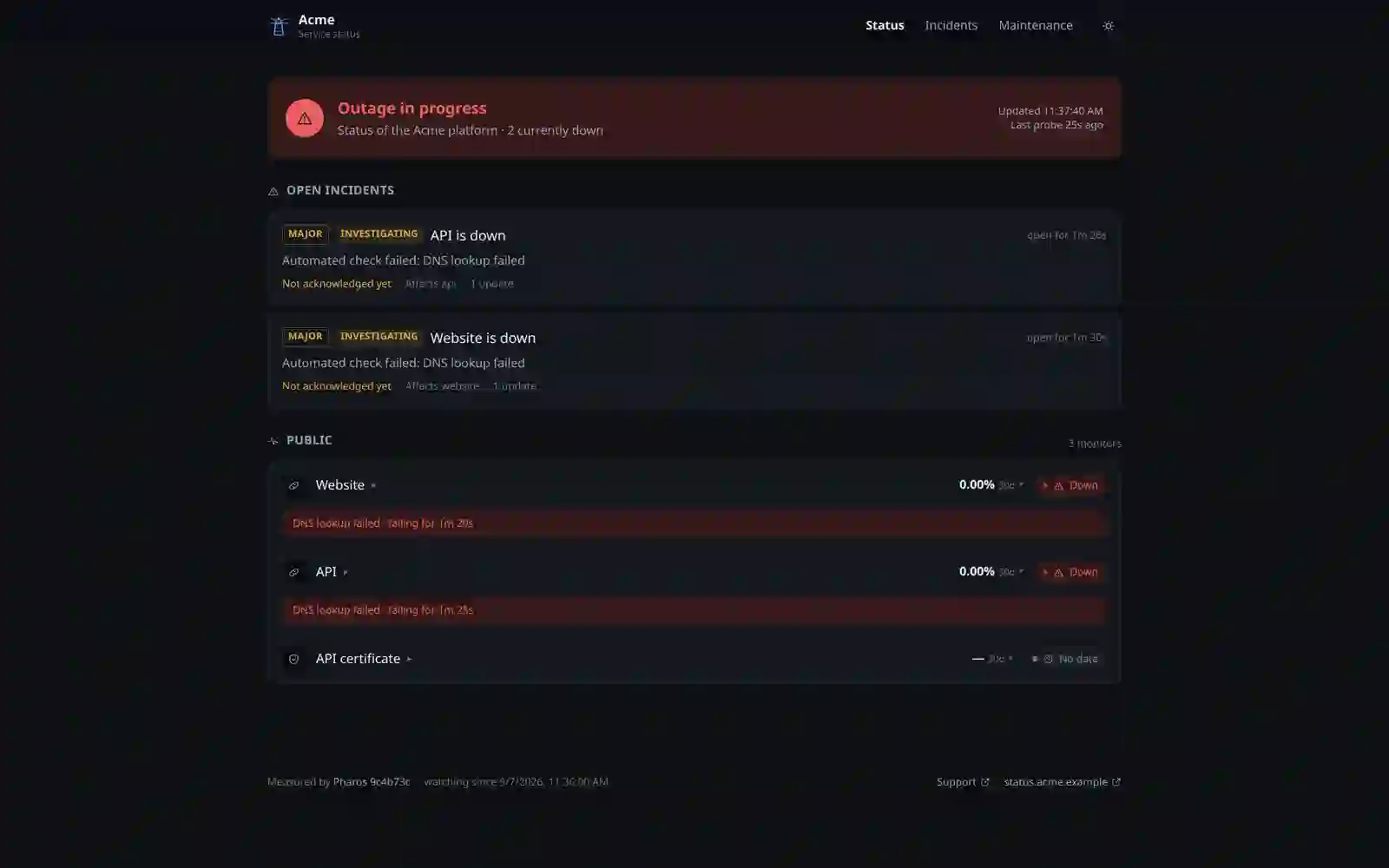
Pharos is our monitor with a status page, the same one as on the laptop at the top. Up close you see the three things it watches: the website, the SSL certificate and the nightly backup.
- The websitePharos checks the site every 30 seconds. The alarm goes off when the site returns an error instead of its content or takes longer than 5 seconds to answer.
- The SSL certificateA certificate only needs checking once an hour. The check fails once fewer than 21 days remain before it expires, which leaves time to renew it without a rush.
- The nightly backupWhen no signal reaches Pharos for 26 hours after a backup, the monitor reports an outage. This monitor does not appear on the public list your customers see.
Each incident shows whether someone has acknowledged it. On Discord, Pharos opens one message with a thread per outage, and its buttons acknowledge and resolve it from a phone. Pharos case study.
How to report a problem or request a change
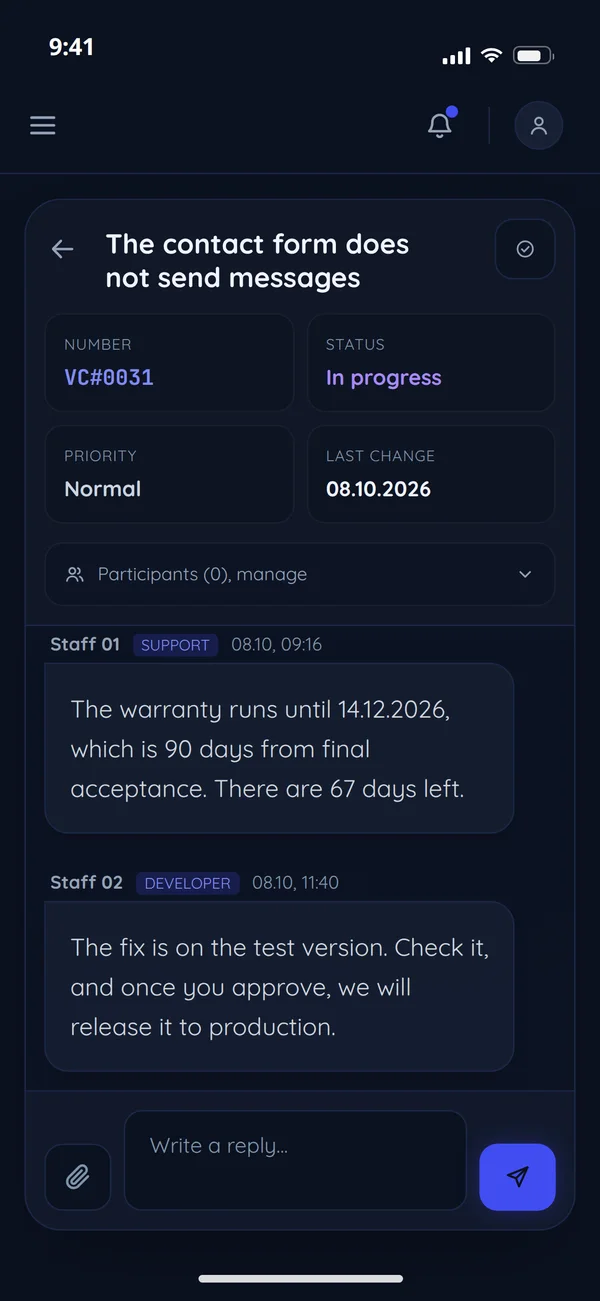
Every request has a status and a history in the client panel where we ran the project.
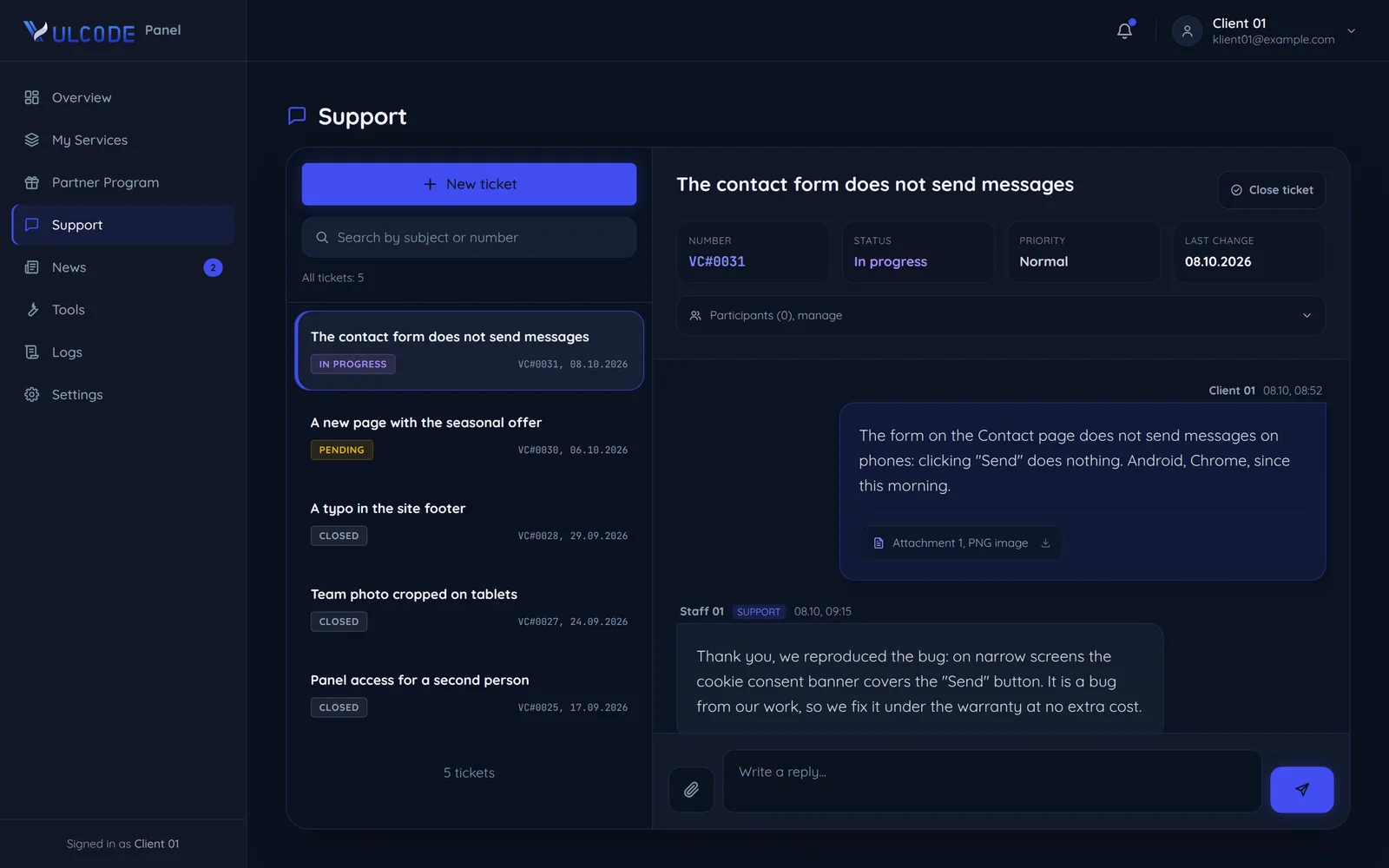
- The requestYou describe the problem or change in the client panel. An urgent matter can also go to the project channel on Discord or Slack.
- AssessmentWe check whether it is a warranty bug, part of the maintenance plan or a new feature to quote, and tell you how we will handle it.
- Test version and releaseThe fix or change goes to the test version first, where you check it. After your sign-off it goes live, and you close the ticket, which stays in the panel history.
Warranty, maintenance or a separate quote
Three things that are often confused. Once we assess a request, you know which of them it belongs to and what it costs.
- A bug from our work
- For example a contact form that does not send messages
- A small change
- A bug after your own code changes, or an outage of hosting we do not run, when the plan covers it
- A new feature
- A bug after your changes or an outage of hosting we do not run, without a maintenance plan
- Our bug reported after the warranty ends, without a maintenance plan (cl. 7.3)
Taking over maintenance from another vendor
Before we take responsibility for a project someone else built, we do four things.
Before the takeover
- Domainon whose account?
- Serverwho has access?
- Outside servicesin whose name?
- Codedoes it build?
- Backupdoes it restore?
- Monitoringwho watches it runs?
After the takeover
- Domain
- Server
- Outside services
Four things to start
- Accounts in your company's name: The domain, server and external services are moved to you instead of staying with the previous vendor.
- A code review: We check that the project builds and can be updated safely.
- A backup: We make a backup and check that it restores before changing anything.
- Monitoring from day one: We switch on monitoring before any changes, to see the starting point.
Common questions about maintenance
Answers about hosting, cost and the support period.

Read next
What to read alongside the maintenance rules.
Need someone to look after your project?
Tell us what you have and what you need. We will propose a maintenance plan and send a quote.