
74 MVP frontends: websites, shops, panels and apps
A set of 74 MVP frontends for fictional brands, each with its own name, logo, palette and style. Websites, shops, panels and web apps sit next to the interfaces of desktop and mobile apps, from a coffee roastery and a football club to a Git client and a mushroom foraging log. Filters, carts, wizards and auctions actually work, and their state stays in the browser.
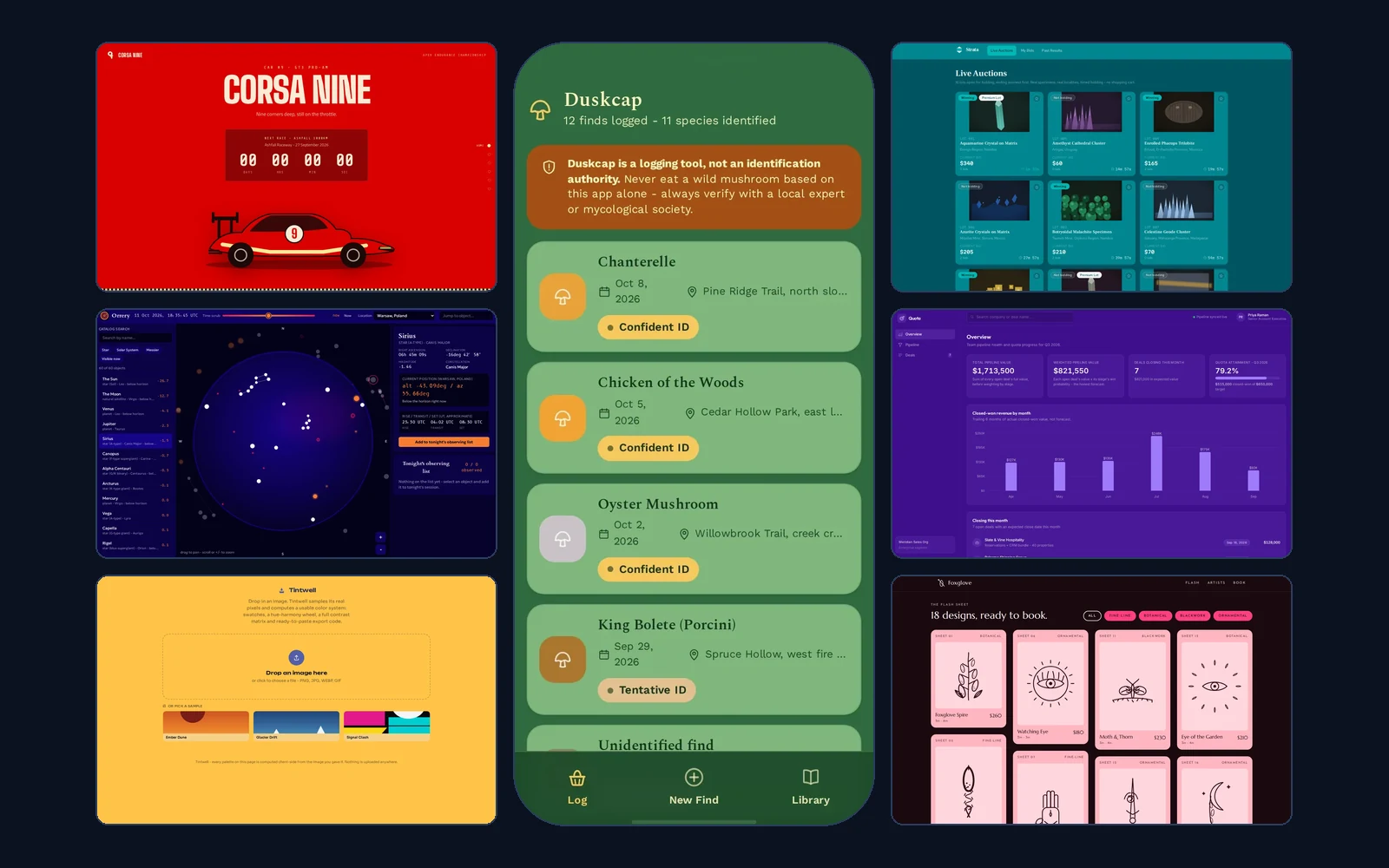
All 74 frontends on their devices
Everything that runs on a computer sits on a laptop, the mobile apps on a phone. Every screen has its brand and industry beneath it, and a clicked screen opens at full size.
Websites12
From a seaside hotel and a natural history museum to a racing team told in full-screen sections, a tattoo studio with a flash sheet and a keyboard configurator with a live preview beside it.
Corsa Nine Racingendurance racing team Casa Marlowseaside boutique hotel Foxglovetattoo studio Almanacnatural history museum The Cruxbouldering gym Switchbenchcustom mechanical keyboards Farwaterseaplane island tours Marginaliaindependent bookshop with a cafe Alcovearchitect-designed homes Ashcombe Athleticsemi-pro football club Sorrel & Stonefarm-to-table restaurant Solaceprivate therapy practice
Shops12
Catalogues with filters, variants and a cart, alongside an auction house with timed bidding and a board game shop where drops open at a set hour with a fixed number of copies.
Stratamineral and fossil auctions Runout Recordsvinyl records Steepwell Tea Co.loose-leaf tea Rookery Gamesboard games Ashgrove Roasterscoffee roastery Trestlefurniture and homeware Inkhollowfountain pens, inks and paper Vesper Cacaobean-to-bar chocolate Kindling Co.bushcraft and fire-craft gear Satchelbakery Wheelhouse Cheese Co.artisan cheese Sillageniche fragrance
Panels12
Dashboards a working day is run from: company finance, a veterinary clinic, fleet dispatch, a hotel front desk, a support queue and a building site.
QuotaB2B sales pipeline Coversrestaurant floor and kitchen Vetflowveterinary clinic Waypointfleet dispatch Millhousecoworking desk and room booking Thresholdhotel front desk Ledgerlinetreasury and spend control Cobblewayparking and EV charging Answerlycustomer support desk Homeroomprimary school office Crewboardconstruction project management Attestinsurance claims handling
Web apps11
Each in a different layout: a kanban board, a six-step wizard, a brainstorming canvas, a CV editor with a live document, a studio schedule, a full-screen map and a BBS terminal.
Tintwellcolour palettes from an image RedlineCV builder Soundingmarine mammal sightings Tackboardbrainstorming canvas FathomwireHTTP traffic inspector Frameforgecustom bicycle builds Farsightrelease roadmaps for game studios Handbillgig poster production Carriera dial-up BBS in the browser Callsheetstudio and gear booking Awl & Oakleathercraft workshop
Desktop apps14
Windows of programs for work at a computer: audio editing on a timeline, photo culling, SQL, API, Git and email clients, a password manager, a drum sequencer and a sky atlas.
Orrerysky atlas for amateur astronomers Lightfoldphoto culling Tapehouse Studiopodcast and audio editing Loomtonestep sequencer and drum machine Zugzwangchess game analysis RowcraftSQL database client Featherlighticon export Postrideremail client GraftworkGit client FetchbenchAPI client Undercroftpassword manager RelaySSH connection manager Foolscapmanuscript writing Layerhouse3D print slicing
Mobile apps13
Phone apps for training, language learning, budgeting, sleep and meal planning, next to a foraging log, a home-brewing logbook and running routes on a map.
Duskcapmushroom foraging log Kittysplitting group expenses Lardermeal planning Wordloomlanguage learning Afterglowlocal live music Sixpencepersonal budget and savings Fernwellhouseplant care Krausenhome-brewing logbook Wagtailpet care Embersetstrength training Driftmarksleep tracking Fieldnotehome inspections Farstridetrail running and cycling
What this set is
This is a set of 74 frontends built as MVPs, each for a different fictional brand with its own name, logo, palette and style, in industries from coffee roasting to astronomy. The brands do not exist, so the set does not describe work for clients. What it shows is how far apart the interfaces we design and build can be.
Every frontend is a separate project with its own code and its own build, not another copy of one template with the colour swapped. Layout, typefaces, icons and motion are chosen for what the company does and who it shows it to.
| Kind | Frontends | For example |
|---|---|---|
| Websites | 12 | Corsa Nine Racing, Casa Marlow, Foxglove |
| Shops | 12 | Strata, Runout Records, Steepwell Tea Co. |
| Panels | 12 | Quota, Covers, Vetflow |
| Web apps | 11 | Tintwell, Redline, Sounding |
| Desktop apps | 14 | Orrery, Lightfold, Tapehouse Studio |
| Mobile apps | 13 | Duskcap, Kitty, Larder |
A brand of its own in every project
Colour here is not one button on a grey background. The brand palette carries the backgrounds, surfaces, cards and headings, so the Ashgrove Roasters coffee roastery is brown from header to footer, the Corsa Nine Racing team red across the full screen and the Strata auction house teal. The palettes come from ready colour sets, and the missing lighter and darker shades are worked out from the same hue instead of reaching for a neutral grey.
Typefaces come in pairs chosen for the brand's character: Fraunces with Manrope for the Casa Marlow hotel, Teko with Inter for the Emberset training app, IBM Plex Sans with Plex Mono for the Ledgerline finance panel. The Carrier BBS terminal writes in a single face, VT323, because that is what the screens it recalls looked like.
Logos and icons are drawn for the industry. The roastery has its own roast-level gauge made of beans, the auction house hand-drawn mineral specimens, and the Lightfold photo culling program a star, a flag and an aperture-shaped logo.
A different layout for different work
The kind of interface is only the start. Among the shops there is Strata, an auction house with no cart, with bidding and a countdown to the end of each lot, and Rookery Games with two tracks: an ordinary shelf with a cart and drops that open at a set hour with a hard limit on copies. Inkhollow sells fountain pens with a choice of nib width.
The websites do not repeat one pattern either. Instead of a header photo Farwater opens on a full-screen, hand-drawn map of the islands with a booking panel, Corsa Nine Racing scrolls through full-screen sections with dot navigation, Switchbench keeps the keyboard preview and the price beside you through the whole configurator, and Foxglove starts straight with a grid of tattoo designs and a style filter.
The web apps do not share one skeleton with a side menu: Handbill is a kanban board, Frameforge a six-step bicycle builder, Tackboard a board you pan and zoom, and Redline an editor with the form on the left and the finished CV on the right. Among the mobile apps Krausen moves from the list to a batch's details through stack navigation instead of a bottom tab bar, and Farstride spreads the run map across the whole screen.
Screens that work
These frontends are not pictures to look at. Filters narrow the catalogue, the cart adds up the total with shipping and survives a page reload, and the price follows the variant: in Trestle a chair with the walnut finish and the wider seat costs exactly what the surcharges add up to. In Tapehouse Studio the play button moves the playhead across the tracks through Web Audio, in Emberset the rest between sets counts down, and Orrery recalculates the altitude and azimuth of the stars with spherical astronomy for the chosen place when you move the time slider.
The numbers on the screens add up. The Alcove mortgage calculator works out the loan amortisation, the Ashcombe Athletic league table counts points and goal difference from the results, the Layerhouse print queue sums the time, material and cost of every item, and moving a deal to won in Quota immediately lowers the value of the open pipeline. Carrier has message boards with threads and replies, file downloads timed by modem speed and blackjack on a full 52-card deck.
Technology and checks
Every project stands on the same toolset: React 19, TypeScript, Vite and Tailwind CSS 4, with the Motion library behind the movement in most of them. There is no backend: the data lives in the project files, and state such as the cart or a reserved tattoo design stays in the browser. That makes it possible to click through the frontend from start to finish before any server exists.
The screens go through a headless browser where their main interactions are clicked, the numbers compared against a manual calculation and the layout measured at phone width, so that nothing spills off the screen. The browser console has to stay empty along the way.
Questions about 74 MVP frontends: websites, shops, panels and apps

More projects
More work from the same category - see how we tackle similar challenges.
Have a similar project?
Get in touch - a quote is free and comes back within an hour.