
GDPR and data processing agreements: when we process data on your behalf
When we maintain your website, move your store or build a panel with a customer base, we get access to personal data that you are responsible for. This is how we keep it in order.
- Controller
- You, the owner of the website, store or system
- Processor
- Michał Fox, VulCode
- § 1Subject, duration, nature and purpose
- § 2Only on your instructionsa
- § 3Confidentialityb
- § 4Securityc
- § 5Sub-processingd
- § 6Help with data subject rightse
- § 7Help with security and breachesf
- § 8End of the workg
- § 9Information and auditsh
You can send your own template. If you do not have one, we will draft an agreement for your approval.
When a processing agreement is needed
Typical situations from our projects. If yours is different, ask and we will assess it together.
An agreement is needed
- Maintaining a website or store. We have access to the server and the database with orders, accounts or form messages. An agreement is needed.
- A migration with a customer base. We move customers and orders to a new system. Throughout the migration we process that data on your behalf.
- A panel or CRM on your data. When we build a system on a real database or import data into it. The agreement is needed from the first import.
- Taking over a project from another company. We receive the code together with the production database. We sign the agreement before we get access.
An agreement is usually not needed
- A new site without personal data. A landing page without a form, or a site whose messages go straight to your inbox. An agreement is usually not needed.
- Working on test data only. We build on made-up data and you load the real data yourself. Then we do not process personal data on your behalf.
What a processing agreement must contain
The list from Art. 28(3) GDPR. Every agreement we sign as a processor has these elements.
- Subject, duration, nature and purposeWhich data, for what purpose and for how long we process it, and the categories of people concerned.
- Only on your instructionsWe process data only on documented instructions from the controller (point a).
- ConfidentialityPeople with access to the data are bound to confidentiality (point b).
- SecurityWe apply the measures of Art. 32, appropriate to the risk (point c).
- Sub-processingWe engage another processor only with your authorisation (point d).
- Help with data subject rightsWe help answer requests from the people the data is about (point e).
- Help with security and breachesWe support you with the obligations of Articles 32 to 36 (point f).
- End of the workWe delete or return the data, as you decide (point g).
- Information and auditsWe provide what is needed to demonstrate compliance and allow audits (point h).
Controller and processor
You decide why and how your customers' data is processed. We only do with it what you ask us to. We are a small team, so this list is short and specific.
You, the controller
You are responsible for your customers' data and the decisions about it.
- You decide why and how customer data is processed
The controller determines the purposes and means of processing (Art. 4(7) GDPR). In your store, panel or website with a form, the controller is you.
- You report a breach to the authority
Within 72 hours of becoming aware, where it poses a risk to people (Art. 33(1)).
- You tell the people when the risk is high
Where the risk is high, the people concerned are told directly (Art. 34).
- You answer the requests of the people the data is about
Access, rectification, erasure, restriction, portability and objection. The request goes to you, and we help carry it out technically.
- You choose whether the data is returned or deleted
Under Art. 28(3)(g) you decide whether we return the data to you or delete it.
Us, the processor
We process data on your behalf (Art. 4(8)), under an Art. 28 agreement.
- Only on your documented instructions
We process data only on documented instructions from the controller (point a).
- Michał "DualFroz" Fox
Developer. Has access to servers and databases when a project task requires it.
- We tell you about a breach
Without undue delay, with what it concerns and what we have already done (Art. 33(2)).
You, the controller: what the breach concerns and what we have already done - We remove the cause and describe the changes
We remove the cause and describe what we changed so it does not happen again.
Sub-processors
Another processor only with your authorisation (point d).
- Hosting and email
The server and email providers we have processing agreements with, as our privacy policy describes.
- The list for your project
The list of entities processing data in a given project is part of its processing agreement.
- Cloudflare Turnstile
Spam protection for the forms on vulcode.com. It concerns our website, not your project.
- Transfers outside the EEA
In your project it depends on the services chosen, and each one is named in the agreement.
Rights of the people the data is about
The request goes to you as the controller. As a processor we help carry it out technically.
- Art. 15
Access
We pull everything about that person from the database.
- Art. 16
Rectification
We correct the data or add a way to edit it in the panel.
- Art. 17
Erasure
We delete the records and related data, including places that are easy to forget.
- Art. 18
Restriction
We flag the data so the system stops using it without deleting it.
- Art. 20
Portability
An export in a structured format another system can read.
- Art. 21
Objection
We switch off the processing the objection is about, for example mailings.
The right to erasure in our panel
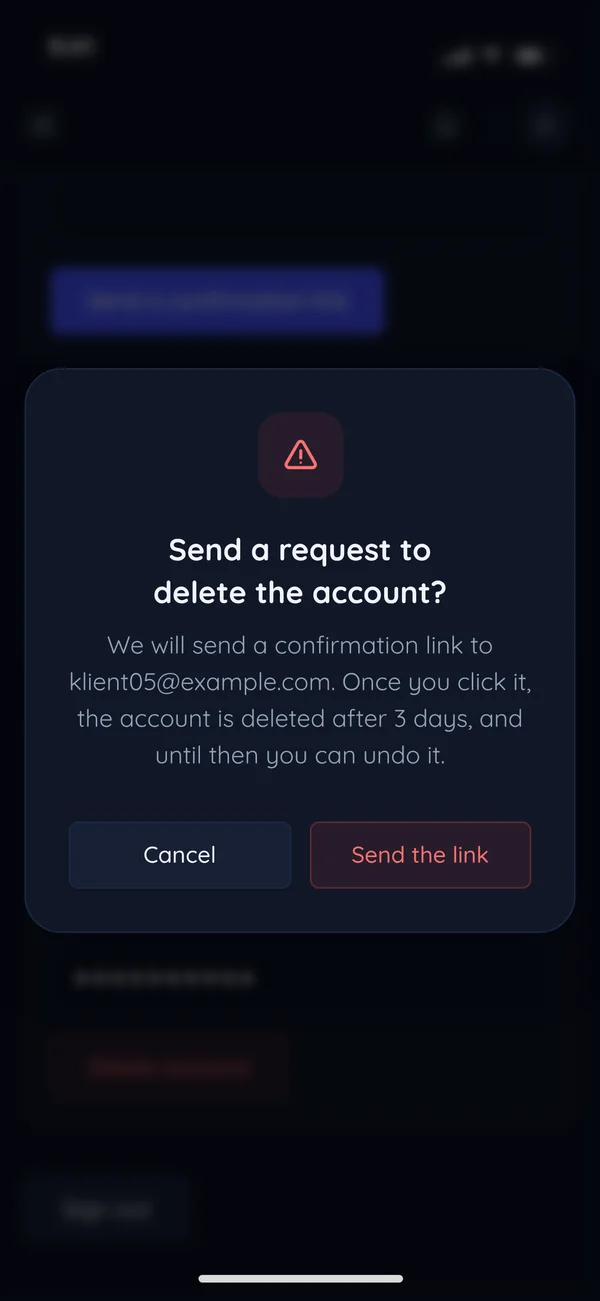
In the client panel we are the controller of your data, and deleting your account is a button in your settings, not a letter to a legal department.
Request in settings
In your account settings you choose to delete the account.
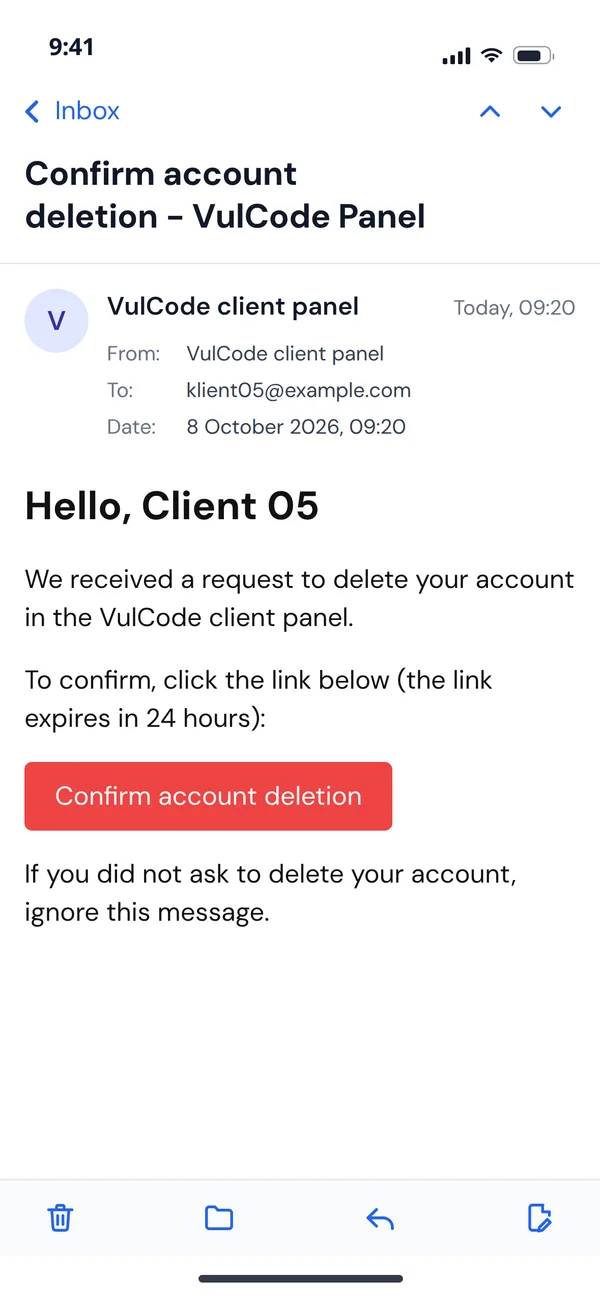
Email confirmation
You get a confirmation link, valid for 24 hours. Nothing happens until you click it.
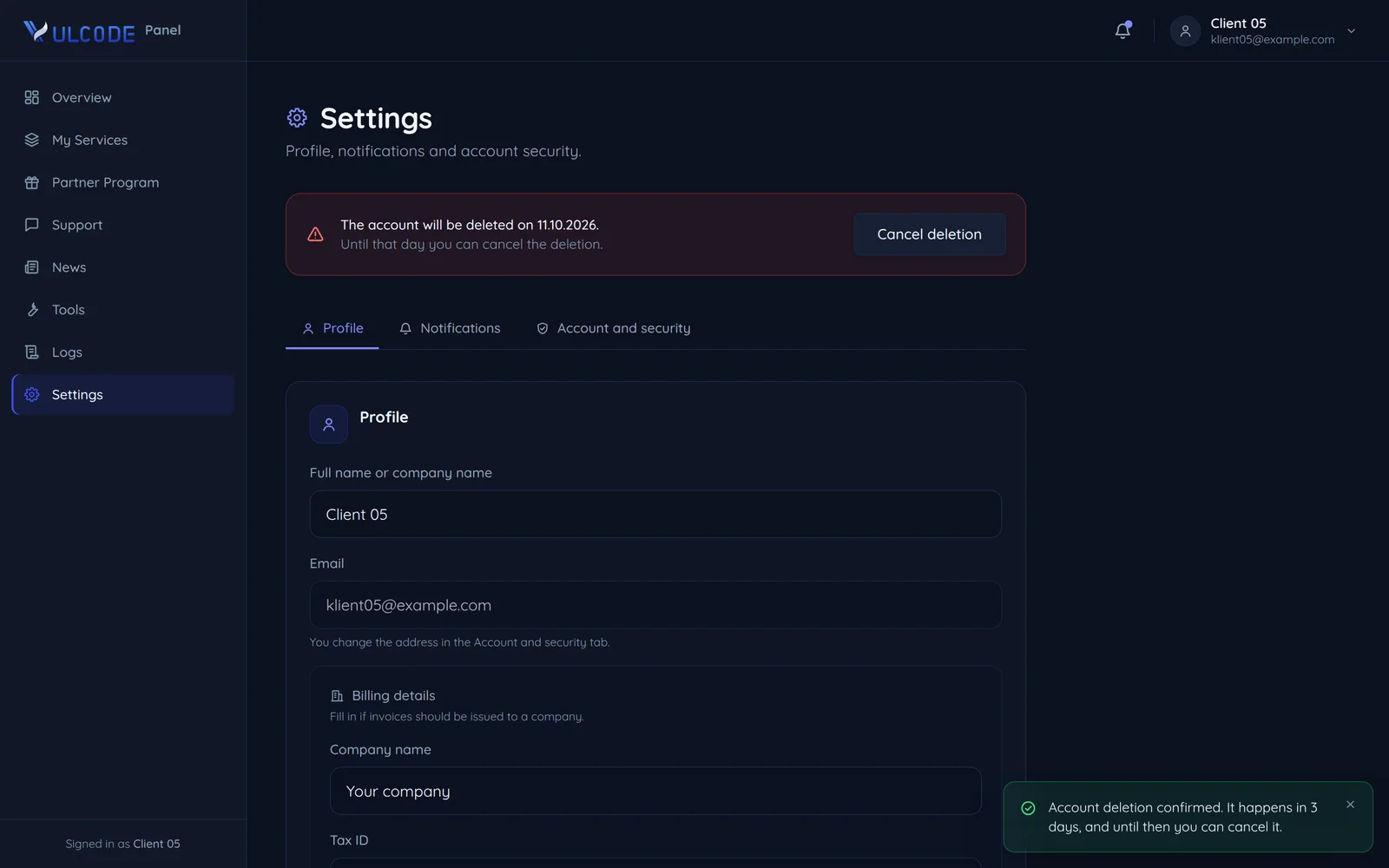
Three days to change your mind
Deletion is scheduled 3 days after confirmation and you can cancel it until then. After three days the account is gone. Accounting documents stay for as long as the law requires.
GDPR questions
What clients ask before signing a processing agreement.

Read next
The documents and pages next to this one.
Need a processing agreement?
Tell us what the project is and what data we will process. We will reply with a draft agreement or comments on your template.