
AI chatbots and language model integrations for business
We build AI assistants that answer from your documentation, not from the model's imagination: on your site, in your client panel or in your team's tools. Every answer has a source, the data stays under control and model costs are worked out before launch. We also say plainly where AI will not work.
Where AI makes sense and where it does not
An AI assistant answers well from the knowledge you give it. It does poorly where every word has to be certain.
Makes sense
An assistant with sources, limited to your knowledge and with a hand-off to a person.
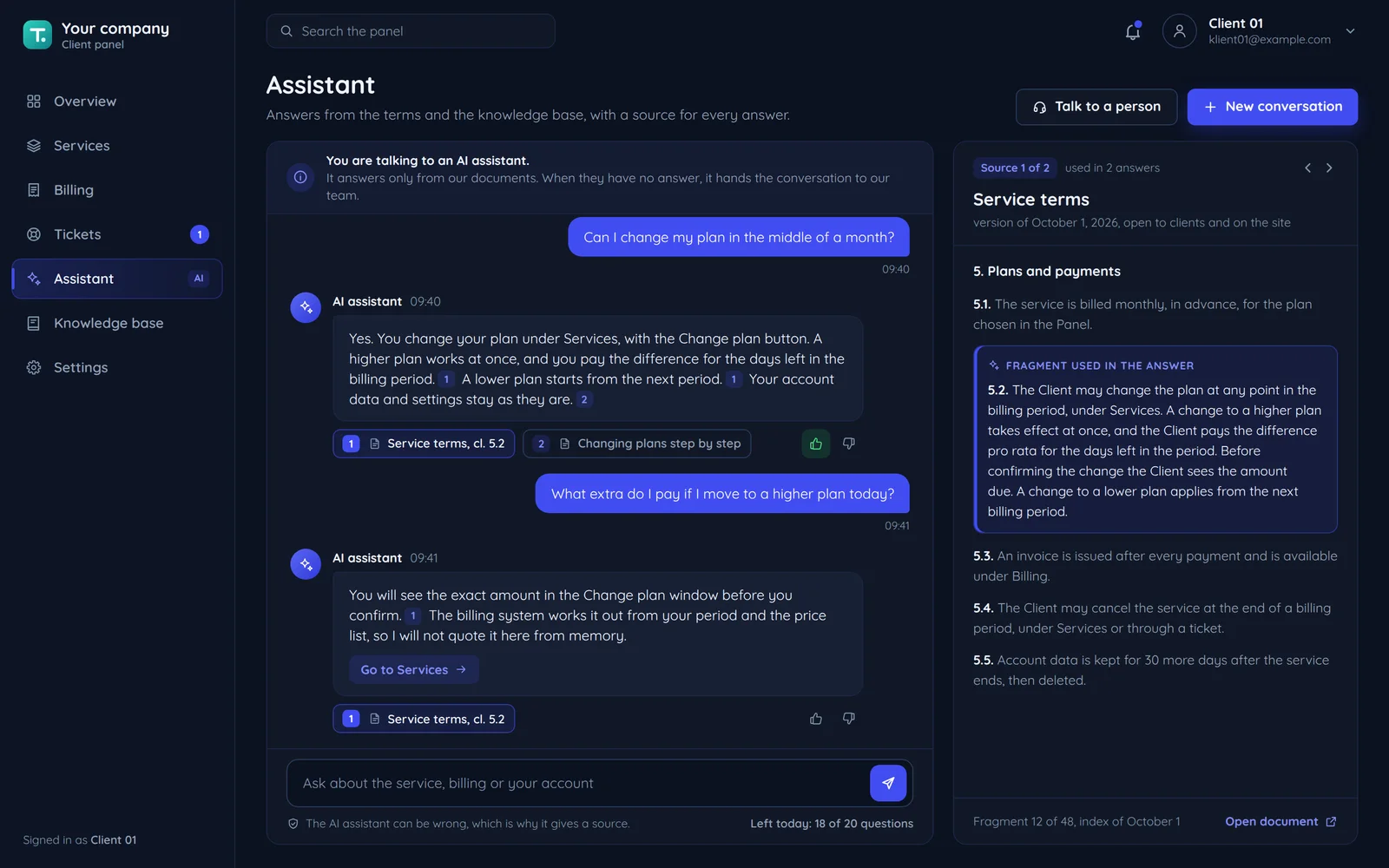
- Answers from documentation, terms and a knowledge baseCan I change my plan in the middle of a month?AI assistantAn answer linking to the clause in the terms
The answer is already written down; the assistant finds it and gives the source, so every answer can be checked.
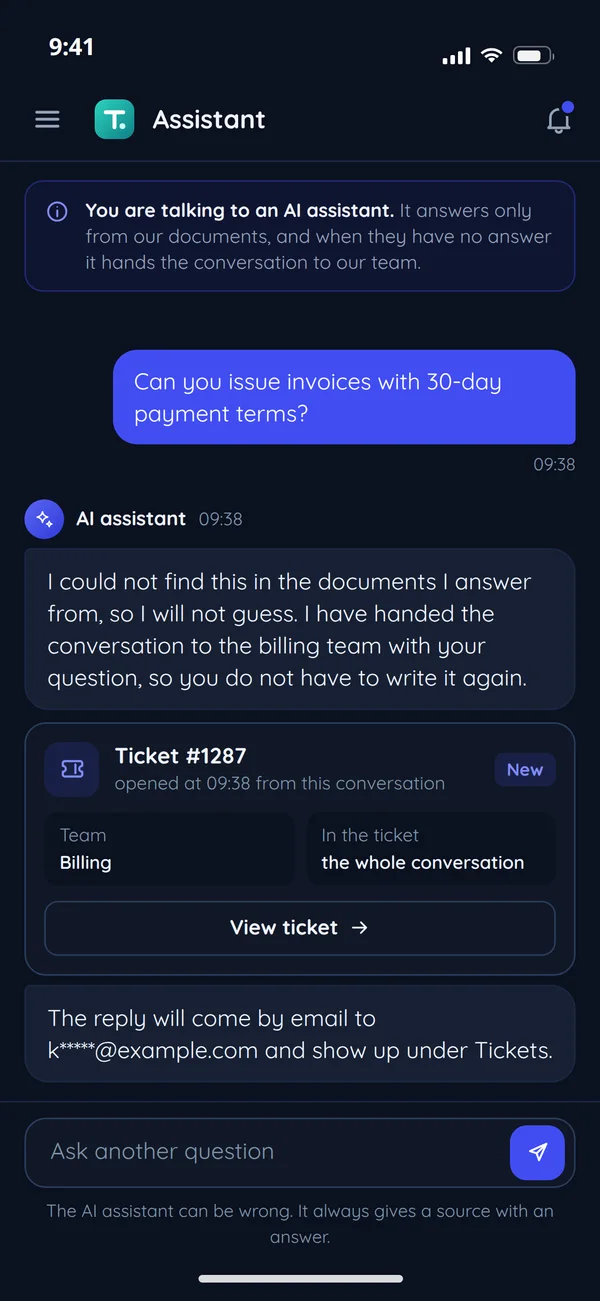
- First-line ticket handling: spotting the topic and collecting detailsI cannot log in since the updateAI assistantA ticket with the topic and details for the team
The team gets the matter with all the details, and people still handle the matter itself.
- Searching company knowledge by meaning, not keywordsHow do I claim a trip abroad?AI assistantThe Business travel procedure
A question worded differently from the document still lands on the right fragment.
Does not make sense
Plain code, a form or process automation fits better here. Cheaper and predictable.
- Legal, medical or financial decisions without a person checkingIs this contract a good deal for me?A personAn assessment someone is accountable for
Here one word changes the decision, and a model can get one word wrong.
- Prices, stock and statuses that change all the timeHow many are still in stock?Plain codeThe warehouse number at the moment of asking
A document index cannot keep up with such changes, and plain code asks the system directly.
- A process a simple rule can describeSend the invoice once the order is paidAutomationThe same result every time
When the result must always be the same, a rule is cheaper and predictable.
How the assistant answers from your documentation
This setup is called RAG: search first, then an answer based on the fragments found.
First this person's conversation limit for the day, against abuse and a surprise bill.
An email address or phone number leaves the question before it reaches search, the model and the log.
Search returns at most 6 fragments of your documents that fit the question best.
- Service terms, cl. 5.2
- Changing plans step by step
- Service terms, cl. 5.3
- Prices and plans
- Billing and invoices
- Account and addresses
- Fragments above the thresholdAn answer from the fragments only
The model gets the fragments found and a limit on the answer's length, and under the answer are links to those it actually cited.
- None above the thresholdThe conversation goes to the team
The model gets nothing; the assistant says it does not know and opens a ticket with the conversation, so the customer does not repeat the question.
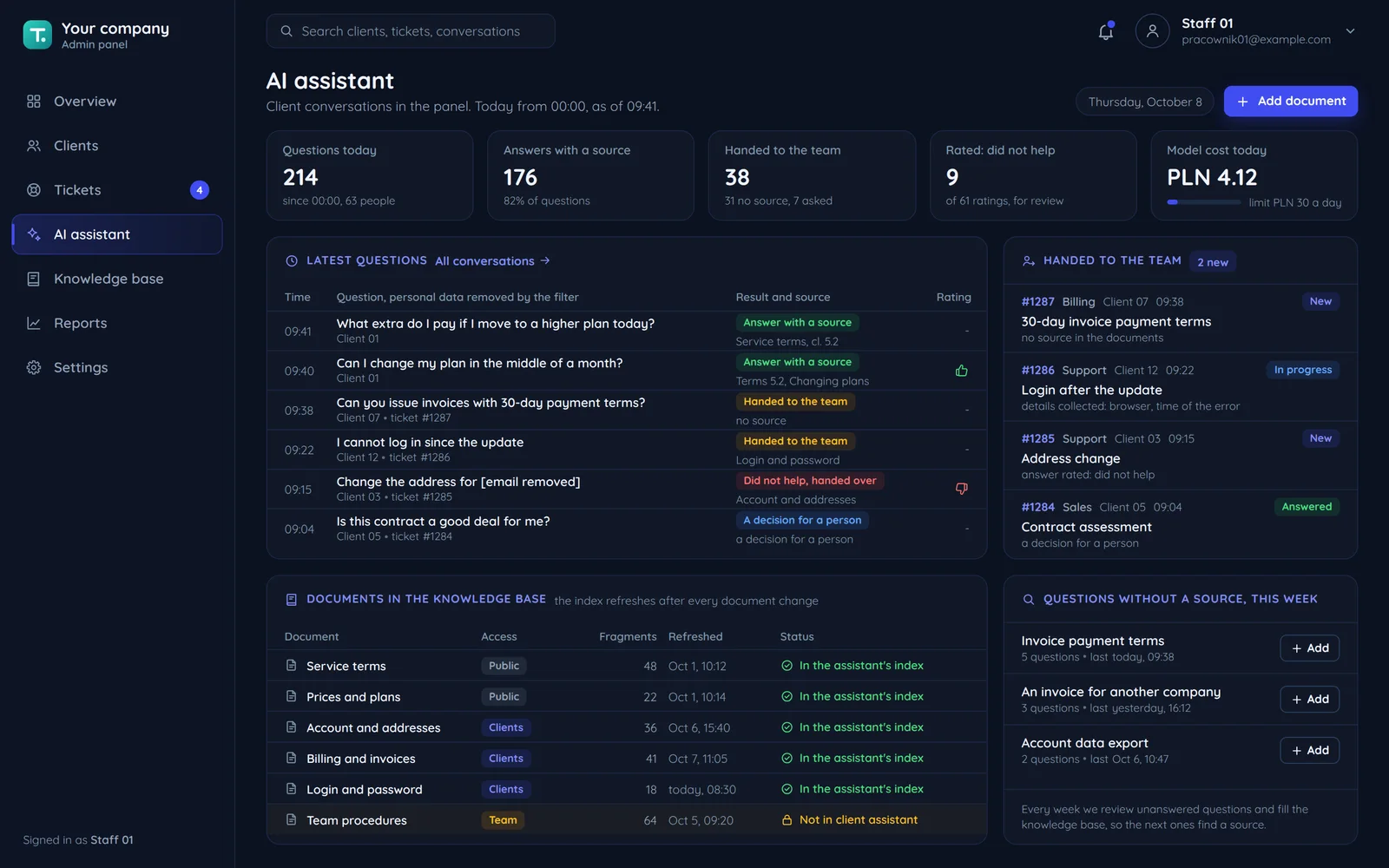
The log. The question, the sources used and the answer stay in the log, which lets you judge the assistant's quality.
What the assistant is made of
The model is only one layer. The others decide quality and safety.
- Interfacewe build itChat on the site or in the panel, a notice that you are talking to AI, a "talk to a person" button.questions and answers
- Your websiteAnswers visitors before they write to your team.
- Client panelAnswers signed-in clients where they already manage their service.
- Team toolsPoints staff to company procedures with a link to the document.
- Controlwe build itLimits and a conversation log, personal data removal, resistance to instruction bypass attempts.hands over conversations with no source
- Ticket systemTakes over conversations the documents have no answer for.
- Knowledgeyour documentsAn index of your documents, refresh after changes, document permissions.An assistant in the client panel sees only the documents that client may access. The team's internal knowledge never reaches the public site assistant.goes into the index
- Knowledge baseThe terms, guides and answers every reply is built from.
- Modela provider or your serverAn API provider or a model on your server, a model matched to the task.fragments in, the answer out
- A model providerA paid service over an API, billed at the provider's rates.
- Your serverWhen the questions must not leave your company.
A rule-based bot, a RAG assistant and an AI agent
Three different things called a chatbot. They differ in what they may do. We start with a RAG assistant: it answers from your documents and always gives the source. Actions in systems come later, one at a time and with a person confirming.
Rule-based bot
Sorry, I did not understand. Pick a topic: 1. Opening hours, 2. Prices, 3. Book a visit, 4. Contact.It looks for keywords and shows a menu when it finds none. It is predictable but never leaves its script.
RAG assistant
You can move the visit in your panel, under My visits, up to a day before it. You will see Friday's free slots when you change the date.It understands the question and answers from your rules, with the source. It changes nothing itself and does not guess free slots.
AI agent
On Friday 9:00 and 10:30 are free. Shall I move your Thursday visit to Friday at 9:00? I will change it only once you confirm.It changes the booking itself, so it needs permissions in the system and constant oversight. A person confirms every action.
Data, rules and oversight
What we check on every AI rollout.
A notice that it is AI
Article 50 of the AI Act requires that a person knows they are talking to AI at the latest at the first interaction. It applies from 2 August 2026, and the chat window says so from the first message.
Personal data
Questions pass through a personal data filter, and conversations are kept only as long as needed.
Log and answer review
We review answers without a source and those rated badly, and the lessons go into the documentation.
Instruction bypass attempts
The assistant has no permissions whose misuse could do harm. Actions in systems need a person to confirm.
What the cost is made of
The AI model is a paid third-party service, billed at the chosen provider's rates, separately from the build. Providers charge for the amount of text processed, so we work out the cost for your number of conversations before launch.
Question length and the number of fragments attached.
We cap it with: Only the best fragments, not the whole documentation. At most 6 go to the model.
Answer length.
We cap it with: An answer length limit.
Larger models cost more.
We cap it with: A smaller model where it is enough.
Traffic on the site and panel. It multiplies every part above.
We cap it with: Per-user limits and caching of common answers.
Model prices change often, so we work out the cost on the chosen provider's current price list at quoting time.
Before rollout we check the provider's terms on how long data is kept and whether it is used for training.
- The build
- An assistant on your site or panel, the documentation index and the hand-off to tickets, quoted by scope.
- AI model
- A paid third-party service at the provider's rates, billed apart.
- Cost limits
- A conversation limit per person and day and a cap on answer length are set before launch, so the model's bill holds no surprise.
- Common answers cached
- Questions that keep coming back are answered from the cache, without another request to the model.
- A model on your server
- When questions must not leave your company, the model runs on your side: you keep a server instead of paying per text.
- Client panel
- Quoted apart, by scope, when the assistant is to work in a panel you do not have yet.
- Support after the warranty
- A warranty of typically 90 days from final acceptance unless the order says otherwise (cl. 7.1 of our terms), then a separate agreement (cl. 7.3).
Common questions about AI chatbots
Answers about sources, data, oversight, the model's cost and the quote.

Read next
Services that often go with an AI assistant.
Want to know if AI makes sense for you?
Tell us which questions the assistant should answer and where its knowledge comes from. We will reply within an hour with an assessment and a quote.