
Vulnerability disclosure: how to report a security issue to VulCode
Found a flaw in our website, client panel or an open source project? Tell us before someone else does. These are the rules that protect both you and our clients.
What this policy covers
The systems we run ourselves. Everything else is its owners' responsibility.
vulcode.com
- vulcode.com and all its pages, in English too
Client panel and API
- The client panel at vulcode.com/en/panel, together with its standalone version
- The site API at vulcode.com/api
Our open source repositories
- Our open source repositories in the VulCodeCom organisation on GitHub
Out of scope
Other people's systems and actions against people
- Our clients' websites and systems, even if we built them
- Services of providers such as Cloudflare, GitHub or Discord
- Social engineering against our team or our clients
- Overloading servers and performance testing
Rules for testing
Look, but so that nobody except you and us notices you were looking. If you follow these rules, we treat your report as help, not as an attack.
Use your own accounts
To test the panel, create your own account. Do not try to sign in to someone else's or guess other people's passwords.
Stop at the proof
Once you see the flaw works, stop. Do not pull more data than you need to show it.
Do not change or delete data
No changes to other people's accounts, projects, invoices or tickets.
No overloading
No load tests and no mass scans. The panel has rate limits and will treat them as an attack.
Leave personal data alone
If you come across other people's data, do not save or share it, and report it to us right away.
Do not publish before the fix
Details stay between us until we fix the flaw and agree with you on what can be described.
How to write the report
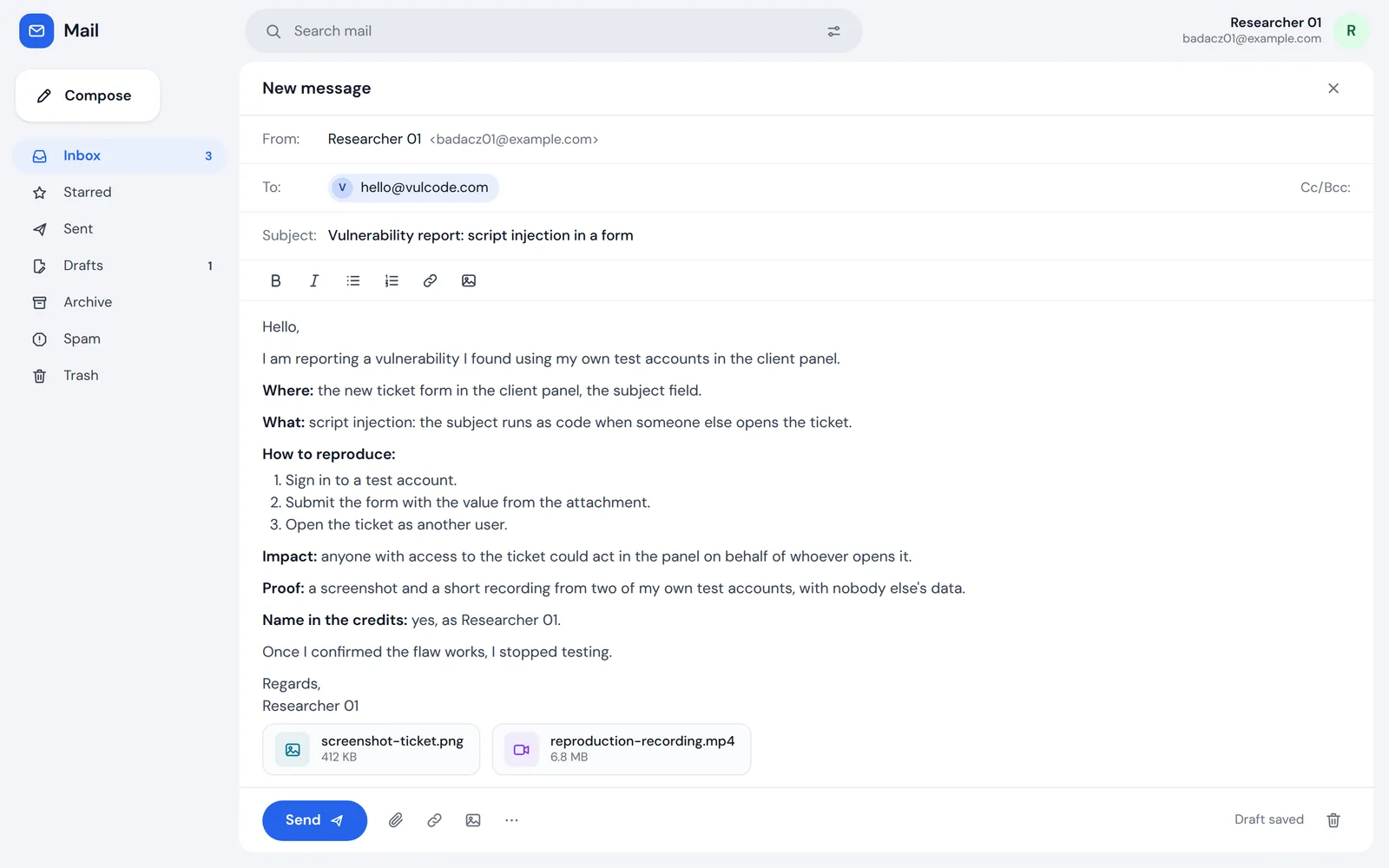
A plain email to hello@vulcode.com is enough. A report like this lets us reproduce the issue straight away.
Where and what
The page address or panel path, the type of flaw and one sentence on what it allows.
How to reproduce
The steps in order, on your own test account, so we can repeat the problem straight away.
Impact, proof and credit
Who could exploit it, a screenshot or recording without other people's data, and whether you want credit by name.
What happens after you report
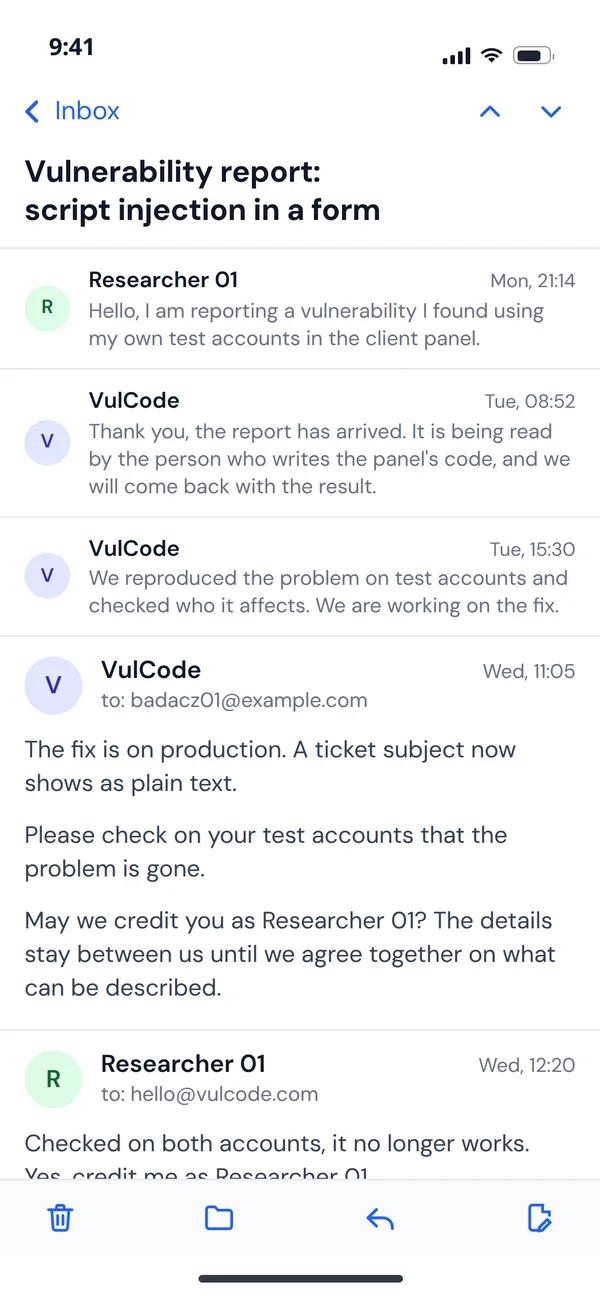
Your report is read by the person who writes the code. There is no form that disappears into a queue.
- ReceiptYou email the report
- UpdateYou check the flaw is gone
- ThanksConsent to credit
- ReceiptReceipt confirmed
- VerificationReproducing it and who it affects
- FixThe fix deployed to production
- UpdateWhat was fixed, in writing
- ThanksThanks under your name
Receipt
You VulCode. We confirm the report arrived and someone is on it.
Update
VulCode You. We tell you what was fixed and ask you to check.
Thanks
You VulCode. With your consent, we say who found the flaw.
Where to report if it is not our system
Not every problem belongs with us, and not every bug is a security flaw. The reporting address also sits in the standard place where tools and researchers look for it.
- A flaw on vulcode.com or in the client panelFollowing the rules on this page.
- A flaw in one of our open source projectsBy email, not in a public GitHub issue, until we release a fix.
- A flaw on a site we built for a clientYou can also write to us and we will pass it on to the client.
- A flaw in Cloudflare, GitHub, DiscordThose are their systems, not ours.
- An ordinary bug that does not endanger dataWe fix it, without the urgent track.
Contact: mailto:hello@vulcode.comExpires: 2027-10-06T00:00:00.000ZPreferred-Languages: pl, enCanonical: https://vulcode.com/.well-known/security.txtPolicy: https://vulcode.com/pl/firma/zglaszanie-podatnosciPolicy: https://vulcode.com/en/company/vulnerability-disclosure
Questions from researchers
What researchers ask us most often before reporting.

Read next
How we protect code, access and data, and where our documents are.
Something to report?
Write to hello@vulcode.com. The subject fills itself in, and the message is read by the person who writes the code.
Report a vulnerability