
Game prototypes and promotional games to order
We build game prototypes, browser games and promotional games for brands. We go down to the engine layer: behind us are a 2D platformer, a voxel engine with a playable browser demo and Game Boy and CHIP-8 emulators written from scratch and checked by automated tests.
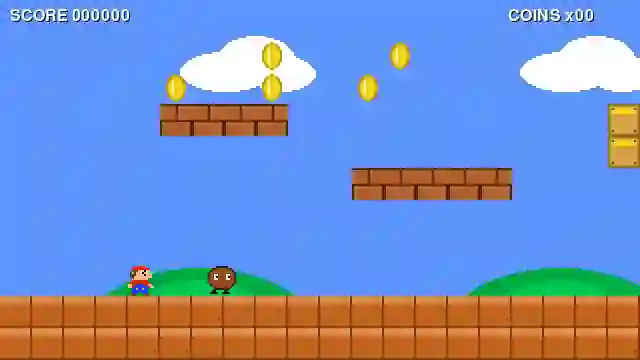
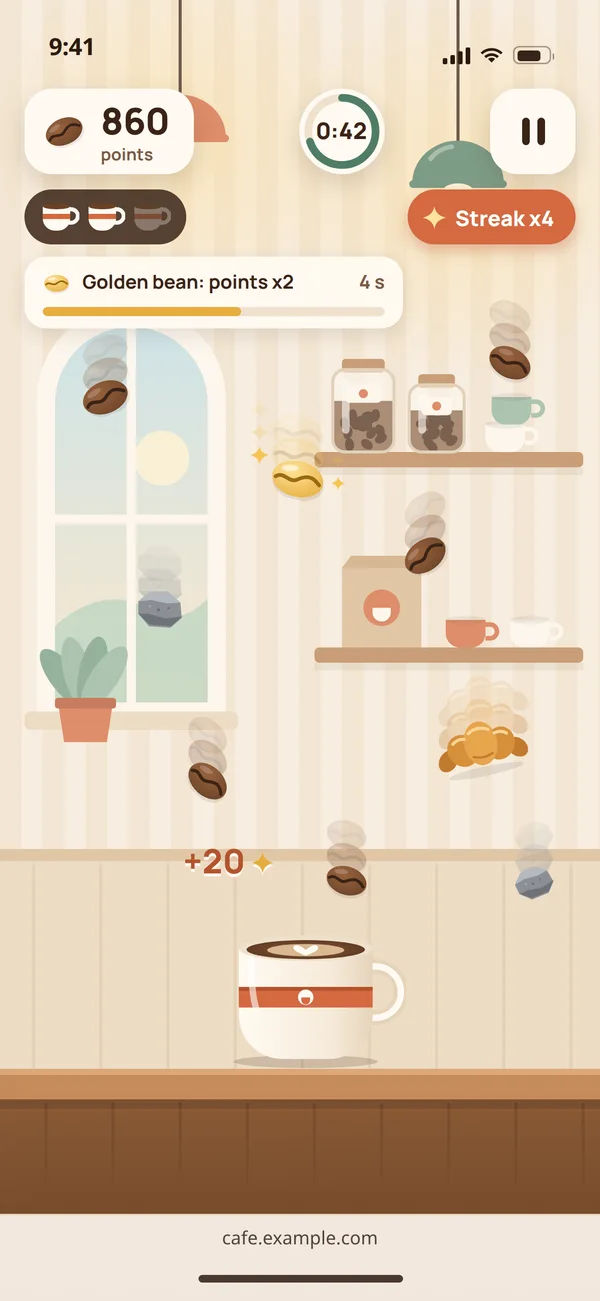
A prototype, a browser game and a promotional game
For clients we do three things: a prototype that tests a mechanic before the budget goes into it, a browser game with no install, and a promotional game that works for a brand. Plugins for existing game servers are on our game plugins page.
A prototype ends in a decision: go ahead, change the idea or stop. Each one comes before the big money is spent.
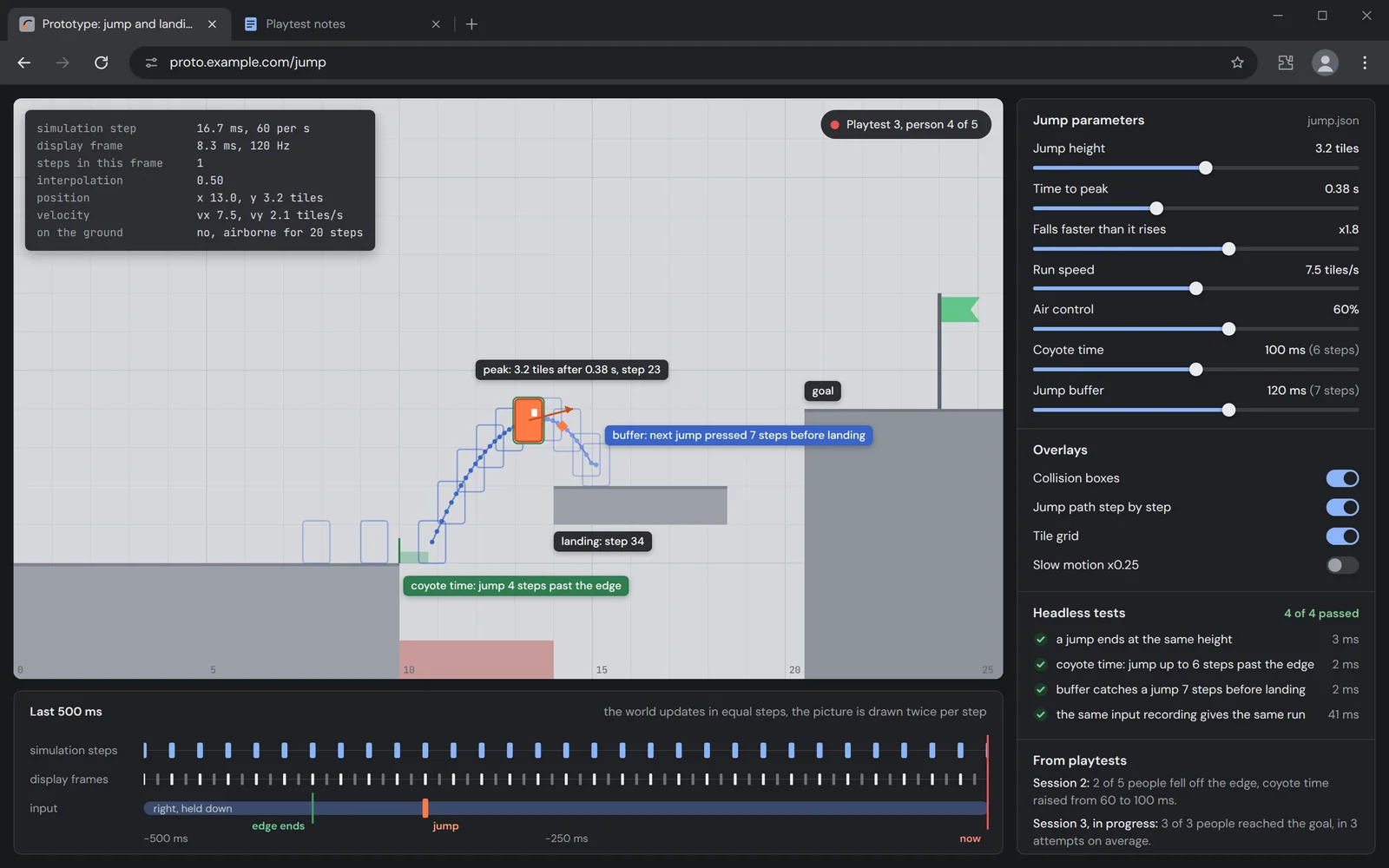
A game loop with a fixed time step
The simulation always runs in the same step, so the game behaves the same on a fast and a weak phone, and its logic can be checked by a test with no window. Our pixel-platformer runs on a loop like this: the world updates 60 times a second, and drawing smooths the motion between steps.
After a pause, such as switching tabs, the loop takes at most 250 ms, which is 15 steps, instead of catching up on the whole pause at once.
A ready engine or custom code
We match the engine to the game: a 3D game for consoles or game stores is built in a ready engine, a light browser game on our own code that loads in a moment. Both roads have the same four layers; what sets them apart is which of them are our code.
A ready engine
We work in the engine that fits the project and write the game logic in it.
- InputengineThe engine handles the keyboard, mouse, touch and gamepad.
- Simulationour codeThe game logic and rules: we write this code, inside the engine.
- RenderingengineThe engine draws the 3D graphics and the art assets.
- PlatformplatformConsoles or game stores.
- A 3D game with lots of graphic assets.
- You plan a release on consoles or game stores.
Light custom code
A small bundle with no heavy engine, with a simulation we test automatically.
- Inputour codeKeyboard and mouse, touch on phones, gamepad. Presses go to the simulation, not straight into movement.
- Simulationour codeA fixed step, physics and collisions, saved state. This layer knows nothing about the screen, so we test it headless.
- Renderingour code2D or 3D graphics in the browser, animations and effects. On weaker hardware they can be scaled down without changing the game.
- PlatformplatformBrowser, fast code for heavy computation, a desktop app. Heavy computation runs in the browser close to the speed of installed programs.
- A browser or promotional game that must load in a moment.
- Simple 2D graphics and one mechanic.
How we will do it: a promotional game for a brand
This is how we build a promotional game, with a cafe as the example: coffee beans to catch in a minute, prizes of the week and a leaderboard that works from the first tap on the link.
Campaign launch
A light bundle that loads fast, and campaign traffic measurement.
The mechanic first, then the brand art
First a grey-box prototype of one mechanic, tried on a few people outside the project. Characters and backgrounds in the campaign colours, made with a designer.
A leaderboard without cheating
Scores checked on the server, not only in the player's browser.
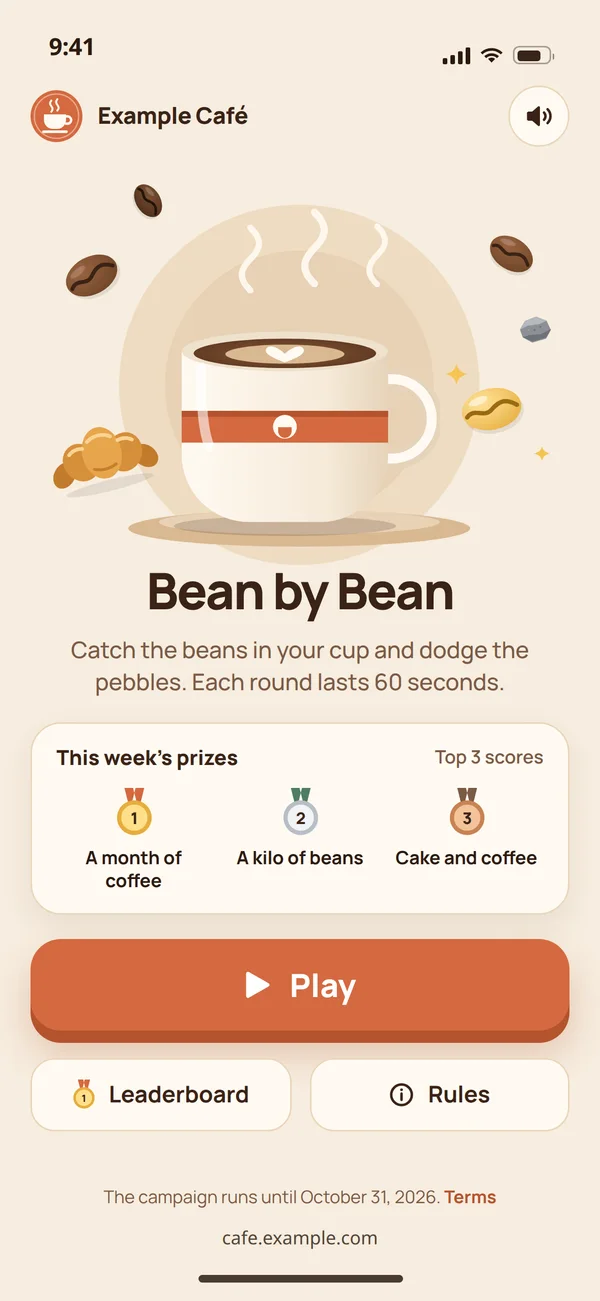
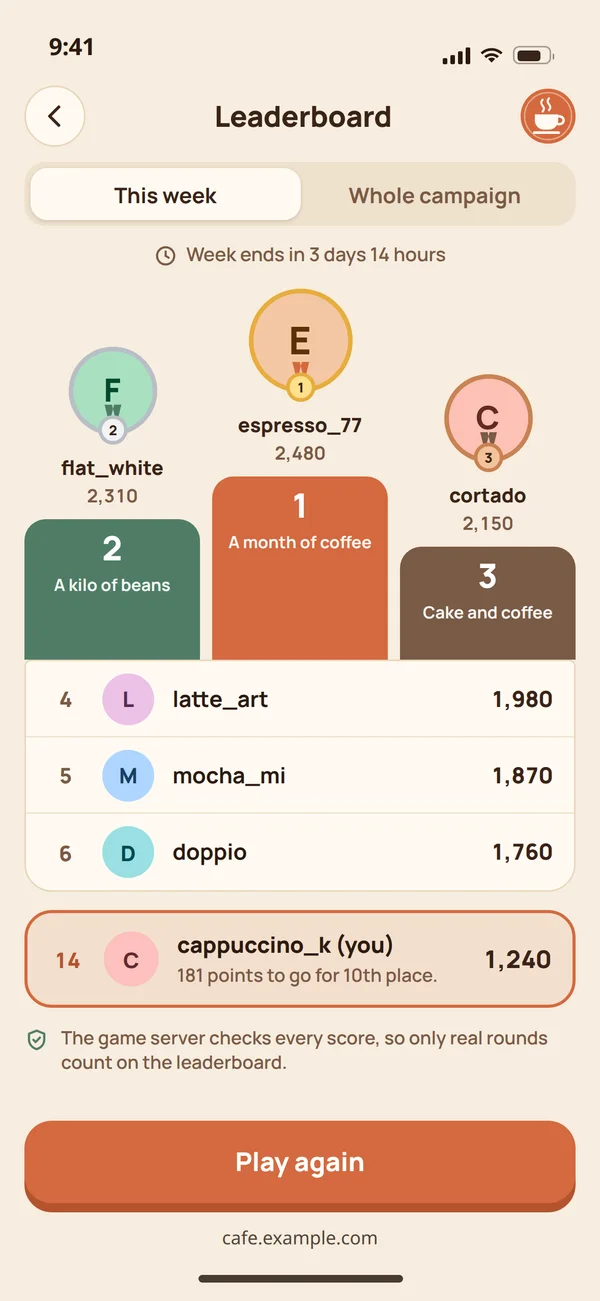
Result: A game playable straight from a link, with a leaderboard you can trust.
From an idea to a game
First we check that the fun works, and only then add art and content.
Idea and rules
We write down the mechanic, the player's goal and what the game runs on.
You get: a one-page game outline and a prototype quote
Grey-box prototype
The mechanic on simple shapes, no art, playable in the browser.
You get: a prototype to play
Playtest
A few people outside the project play while we watch where they get lost or bored.
You get: a decision: go on, change or stop
Production
Art, sound, levels and saved progress, with a test build after each stage.
You get: a game ready to release
Release
Publishing in the browser or as an app, with measurement of how people play.
You get: the game with players
The first document: a one-page game outline
- When
- after the first call
- Together with
- the prototype quote
- Mechanicwhat the player does most of the timeDescribed so it can be built before any art exists.
- Player goalwhen they win and why they come backWithout a goal, a playtest has nothing to check.
- Controlstouch, keyboard or gamepadIt decides whether the game needs on-screen buttons.
- Runs ona phone, a computer or bothIt sets the devices we test on and how large the game bundle can be.
- The prototype testsone question about the funA prototype answers one question, so the quote covers only that.
- Left for laterart, sound and more levelsWhat the prototype leaves out on purpose. It returns in production once the mechanic holds up.
Projects that show our craft
These are our own games and engines. Each project has a portfolio write-up of what we built and why.
A jump tuned value by value
Jump force, gravity and landing friction, tuned one at a time until the jump feels right in the hand.
Collisions on X and Y apart
Velocity first, then each axis on its own against the tile grid, with the position corrected on impact.
60 steps a second
The world updates in a fixed step whatever the monitor, and drawing smooths the motion between steps.
- pixel-platformer
A 2D pixel-art platformer that runs in the browser
Jump physics tuned value by value, collisions computed on the X and Y axes separately, a simulation 60 times a second.
- voxelforge
A voxel engine with a playable browser demo
3D graphics in the browser with no install, a simulation independent of drawing, tens of thousands of checks in tests.
- gameboy-sharp
A Game Boy emulator written from scratch
The whole console rebuilt in code and checked automatically on standard test programs.
- chip8-sharp
A CHIP-8 emulator written from scratch
The full instruction set checked automatically on community test programs.
- warren
A roguelike with persistent progression, driven from the terminal
Generated runs, classes and mutators, and checks that the same run always ends the same way.
- gambit
A chess engine
Move generation, position evaluation and search.
The same craft beyond games: our own operating system kernel, a database engine, a program that solves logic puzzles and our own programming languages.
Games, emulators and engineering projectsCommon questions about custom games
Answers about art, phones, small jobs, pricing and the game code.

Read next
Services and projects related to games.
Got an idea for a game?
Describe the mechanic and who the game is for. We will reply within an hour with questions and a prototype proposal.