
Marketplace integration: Erli, Empik, Amazon, Temu
Every marketplace has its own API, rules and pitfalls. We connect them to your store and warehouse directly or through a multichannel tool, so there is one stock level and orders land in one place.
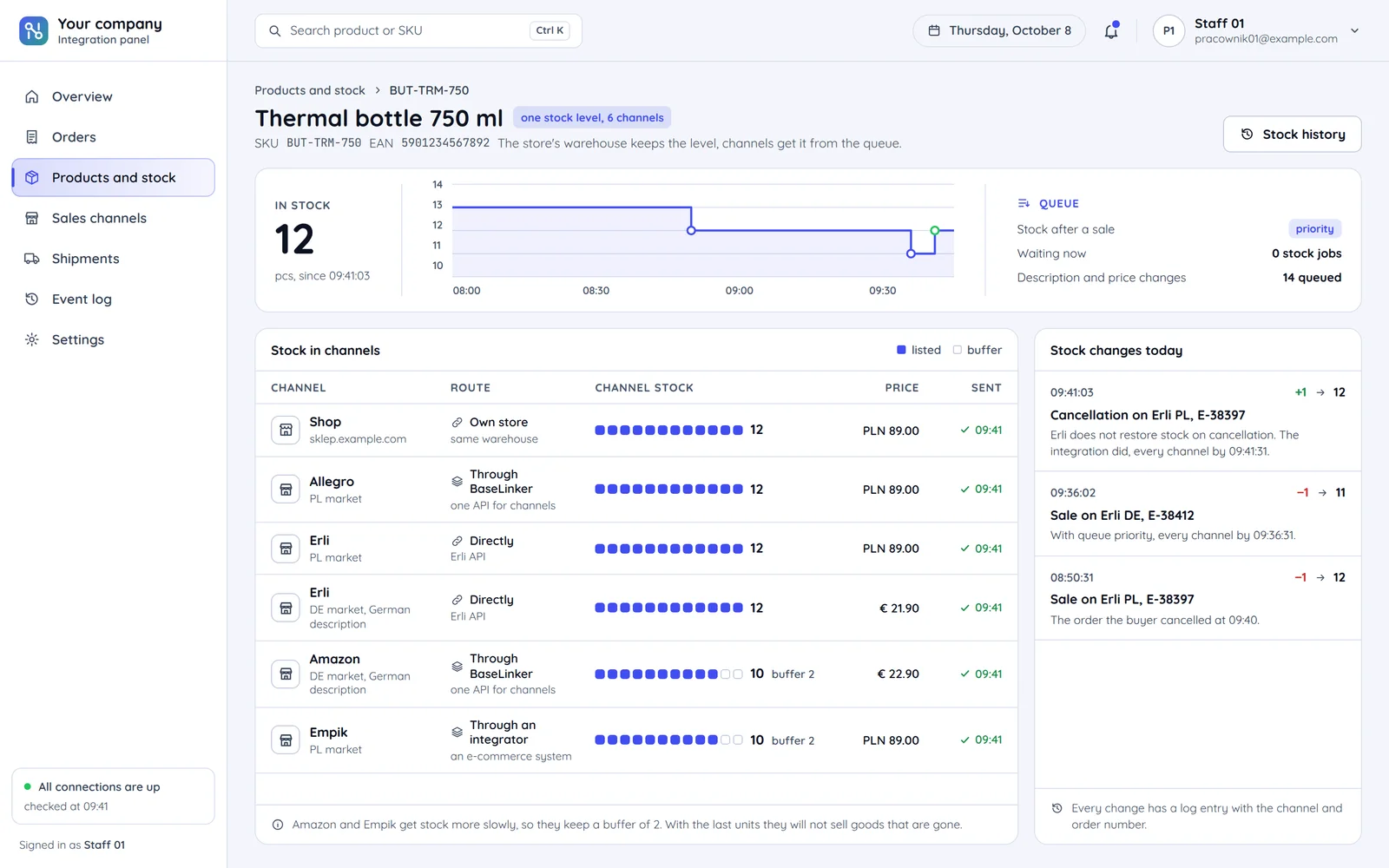
Four marketplaces from the integration side
Each one connects differently, so for each we pick the surest route: directly via API or through an integrator.
| Erli | Empik | Amazon | Temu | |
|---|---|---|---|---|
| A seller API of its own | ErliyesYes, a key from the shop panel | Empikper arrangementPer arrangement with Empik | AmazonyesSelling Partner API | Temuper arrangementPer Temu's partner programme |
| Via e-commerce systems and integrators | Erliyese.g. Sellasist | Empikyese.g. Magento, IdoSell, xSale | Amazonyese.g. Sellasist or BaseLinker | Temuyese.g. Sellasist |
| How the integration gets access | ErliyesAn API key from the shop panel | Empikper arrangementDepends on the route | AmazonyesRegistering the integration and the seller's consent | Temuper arrangementDepends on the route |
| Our most common route | ErliDirectly via APIProducts by your own identifier, changes in batches, and orders with their changes in one event inbox. | EmpikThrough an integratorEmpik works with e-commerce systems, and products can also be added in the Seller Panel. | AmazonDirectly or through an integratorEach Amazon market has its own listings and prices, and we track request limits per operation. | TemuThrough Sellasist or another integratorSellasist has a ready link with Temu, Amazon and Erli. |
Erli: orders through the event inbox
Erli collects new orders and their changes in one place, the inbox.
The way of an Erli order
- Customer on Erlipurchase and payment
- Erli inboxorderorder events
- Integrationevents fetchedfetches, acknowledges, storesPaid: fulfilCancelled: stock does not return by itself
- Your warehousepaidfulfilment and shipping
- Erliorder updatestatus and tracking number
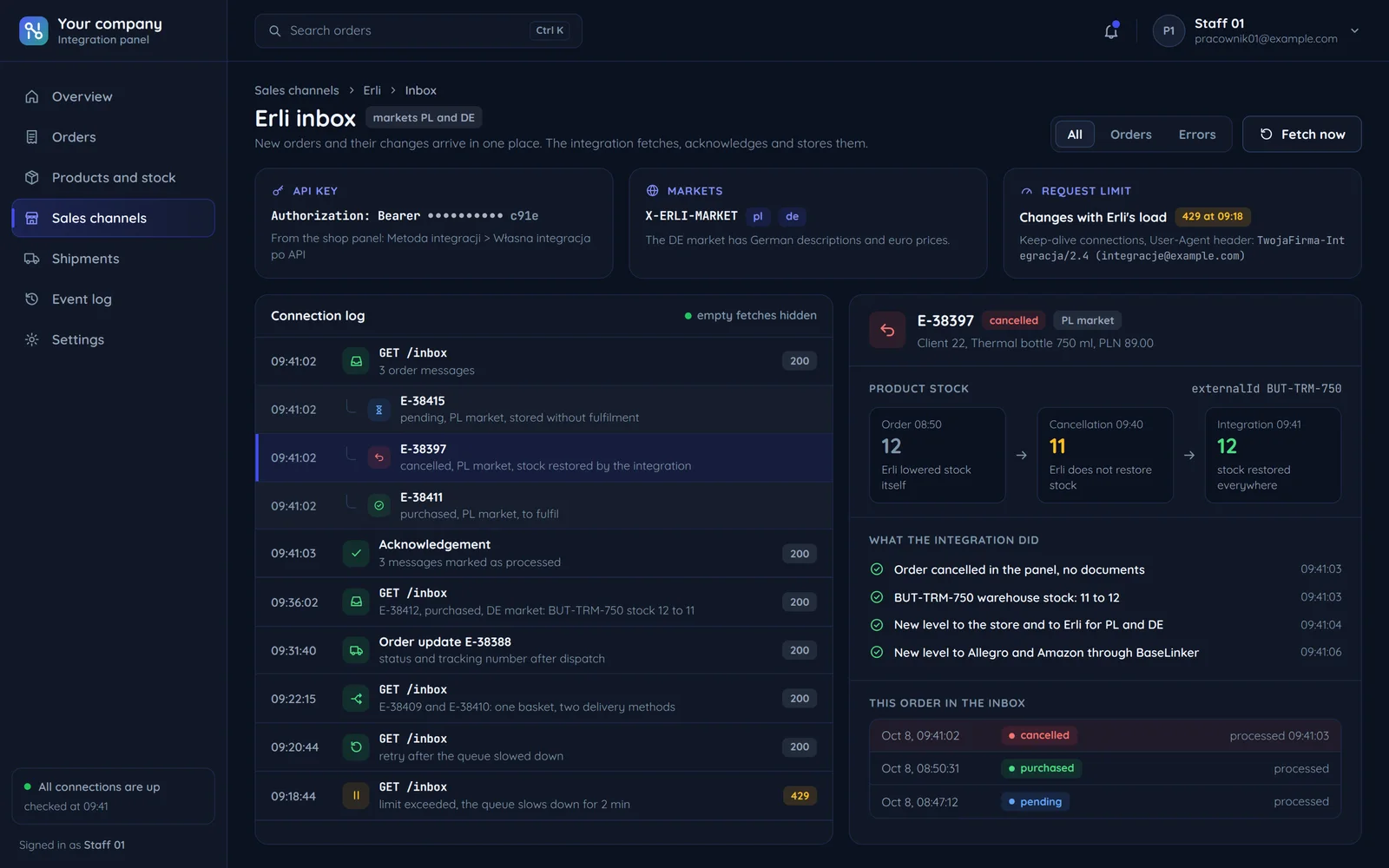
One event inbox
The integration fetches new messages, acknowledges them and stores the order. The integration reads every order from it, so none goes missing.
The stock trap
Erli lowers stock automatically on order but does not restore it on cancellation. The integration has to do it.
Two markets
A shop can sell in the Polish and German markets. The integration names the market with every change, so translations and prices land where they belong.
Each one's pitfalls
Details that break integrations when someone treats every marketplace the same. We handle each one its own way.
Erli: the limit moves with load
The request limit varies with the service load, and Erli turns excess requests away. A queue that slows down by itself when Erli turns requests away, so no change is lost.
Erli: one basket, several orders
Several delivery methods in one basket create separate orders. We group them in your system by buyer and time if you prefer to pack that way.
Empik: delivery is on your side
The seller handles delivery, with several methods to choose from. We map Empik's methods to your couriers and pickup points.
Amazon: a limit per operation
Each operation has its own request limit, and the app's credentials must be replaced regularly. A separate counter for each operation and a credential replacement reminder in the panel.
Temu: access through the partner programme
Integration access depends on the partner programme. We usually connect Temu through a multichannel tool that already has the link.
A route matched to the number of channels
We match the route to how many marketplaces you run: with one main channel we connect it directly, with several through a multichannel tool, and often we combine both.
Directly via API
one main channelOne marketplace drives a large share of sales. The integration should be part of your system, not one more service.
An integration with the marketplace API in your code, with its limits and pitfalls handled directly.
Each channel its own way
some through a middlemanAmazon goes into BaseLinker, which already handles Allegro. Erli connects directly to cover two markets and the inbox.
Some channels through a middleman, some directly, with orders and stock in one place.
Through a multichannel tool
three or moreYou want one panel for orders, labels and messages. The marketplace gives you no direct API.
BaseLinker, Apilo or Sellasist as the hub, with your system connected to it through one API.
one main one
Directly via API, one main channel
One marketplace drives a large share of sales. The integration should be part of your system, not one more service.
An integration with the marketplace API in your code, with its limits and pitfalls handled directly.
another channel beside the main one
Each channel its own way, some through a middleman
Amazon goes into BaseLinker, which already handles Allegro. Erli connects directly to cover two markets and the inbox.
Some channels through a middleman, some directly, with orders and stock in one place.
three marketplaces
Through a multichannel tool, three or more
You want one panel for orders, labels and messages. The marketplace gives you no direct API.
BaseLinker, Apilo or Sellasist as the hub, with your system connected to it through one API.
three or more
Delivery from marketplaces
On Empik and Erli delivery is the seller's job, and methods must map to your couriers.
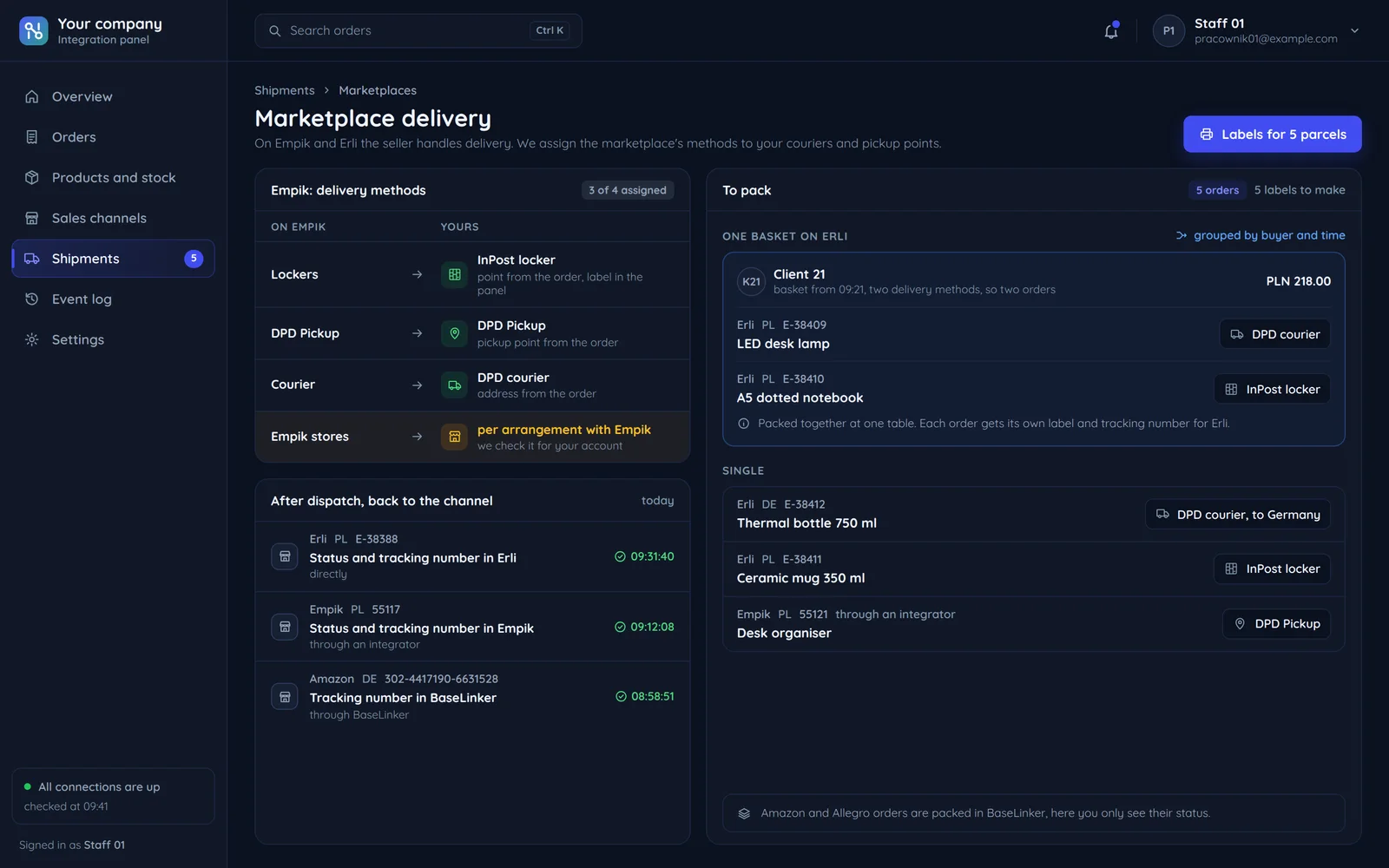
Empik's methods on your couriers
We assign every Empik delivery method to your courier or pickup point. Delivery to Empik stores is checked for your account.
On EmpikAt your end- Parcel lockersa locker, the point from the order
- DPD Pickupthe DPD Pickup point from the order
- courieryour courier, the address from the order
- Empik storesper arrangement with Empik
One basket, two orders
Parcels from one basket can be packed together, and each order still gets its own label and tracking number for Erli.
One basket on Erliorder, method 1order, method 2one packing, each parcel with its own labelThe status and tracking number go back to the channel
Once the parcel is dispatched, the integration sends the status and tracking number to the marketplace: to Erli directly, to Empik through the integrator.
Common questions about marketplaces
Marketplaces, stock, cancellations, delivery and orders

Read next
The systems we most often connect marketplaces through.
Which marketplaces do you want to sell on?
Tell us where you sell today and where you want to start. We will reply within an hour with an integration route and a quote.