
Shopify integration with Allegro, InPost and Polish payments
Shopify works well worldwide, but the Polish market has its own needs: Allegro, parcel lockers, BLIK, wholesalers and KSeF. We connect them to your store through a custom Shopify app built on the GraphQL Admin API.
The Polish market around a Shopify store
Some of these connections have ready apps or plugins. We write the rest as an app for your store.
Allegro
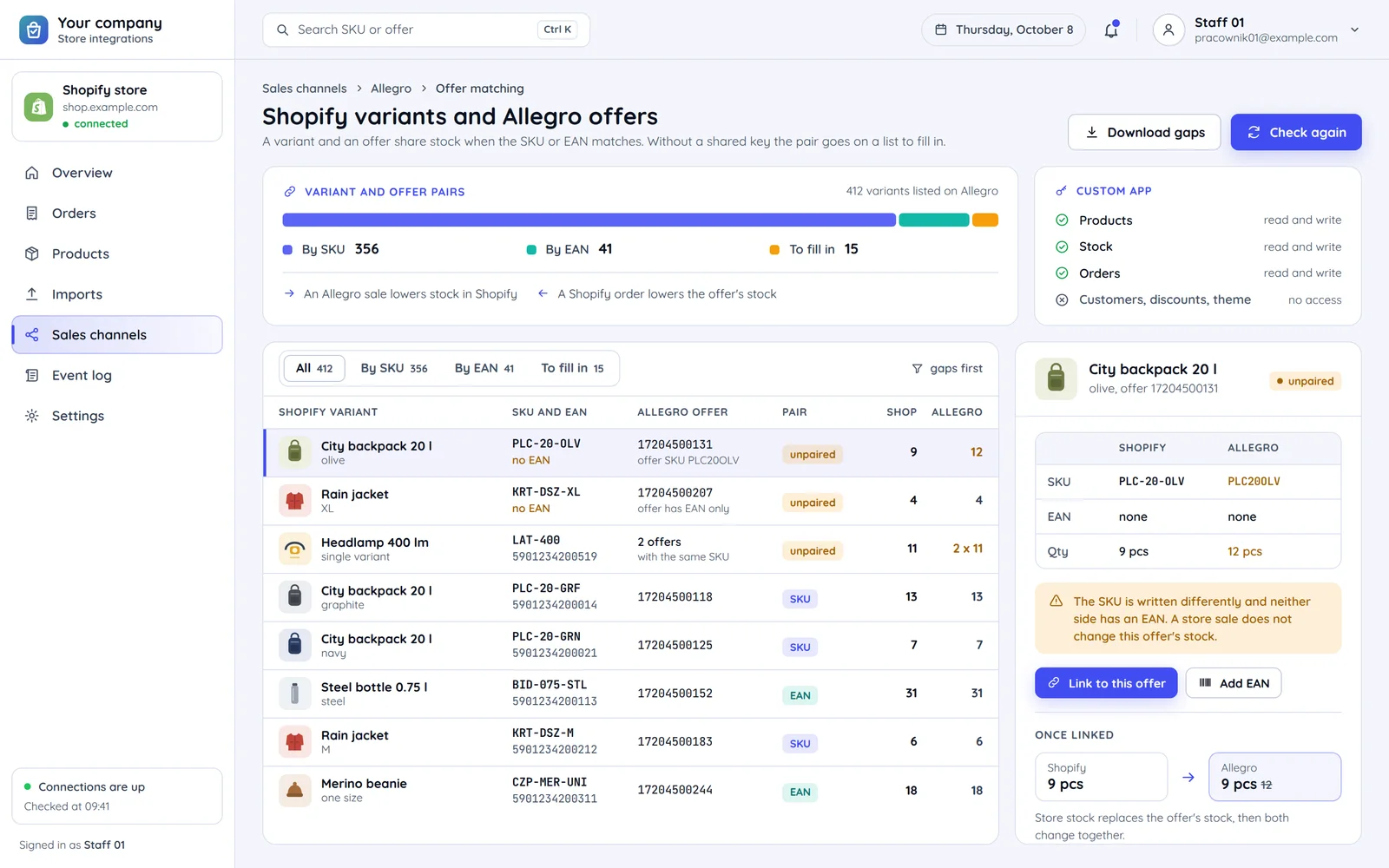
Our code. We match variants to offers by SKU or EAN, and gaps go to a list to fill in.
- StockAllegroShopify storea sale on one channel lowers stock on the other
- Allegro ordersAllegroShopify storeare created in Shopify
- An order to shipShopify storeInPost
- Fulfilment and trackingInPostShopify storeonce the parcel is dispatched
- The order paymentPrzelewy24 and BLIKShopify store
- Wholesaler productsWholesalersShopify storea new file or a wholesaler API change
KSeF
Our code. Your invoicing app or ERP issues the invoices. Shopify does not send invoices to KSeF itself.
- An order to invoiceShopify storeKSeF
- The invoice with its KSeF numberKSeFShopify storea link in the customer account or email
- Sales channel dataBaseLinkerShopify store
GraphQL, not REST
We build new integrations on the GraphQL Admin API. An app for one store can still call REST, but there is no reason to start with something Shopify is retiring.
Shopify itself is retiring REST
The REST Admin API is a legacy API as of October 1, 2024. Starting April 1, 2025, all new public apps must be built exclusively with the GraphQL Admin API.
Limits counted by query cost
items at most in one input array. In GraphQL each query has a cost, so we fetch only the fields needed and split changes into batches.
- 25 000objects at most when paginating an array
- 10 000new variants a day in a store with 500,000 variants
An import planned around the limit
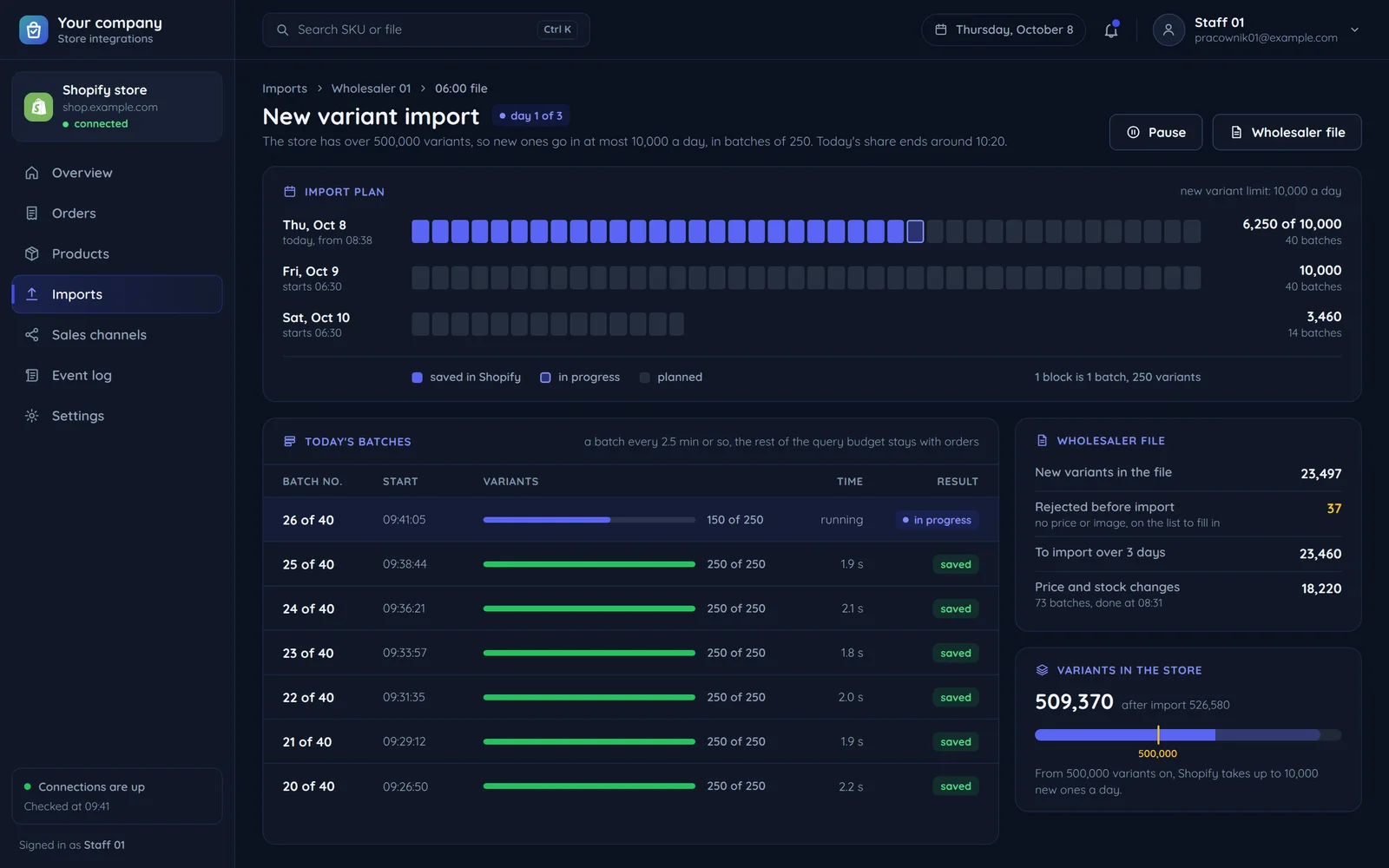
Over 500,000 variants: new ones go in at 10,000 a day, in batches of 250, and the import ends on the third day.
A Shopify webhook verified and handled in time
Shopify waits 5 seconds for a reply and may send the same webhook more than once. Once a day a reconciliation job checks through the API that none was lost.
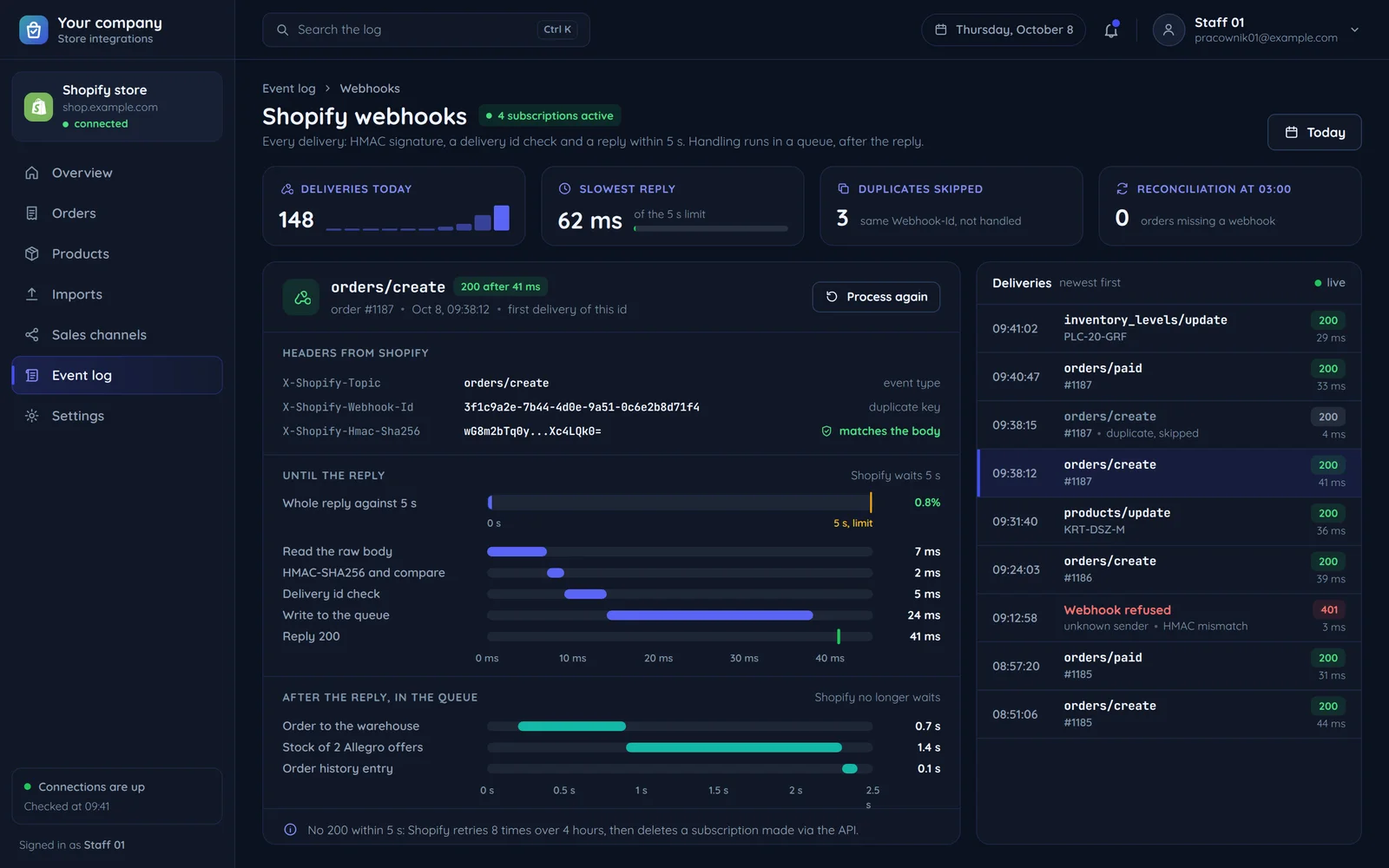
- X-Shopify-Hmac-Sha256A signature over the raw bodyHMAC-SHA256 of the raw body, keyed with the app's client secret, compared with the X-Shopify-Hmac-SHA256 header. A mismatch gets a 401.
- 200A reply well inside 5 secondsThe receiver replies at once, while the order for the warehouse and the Allegro stock go through a queue. After 8 failed tries over 4 hours Shopify deletes a subscription made via the API.
- X-Shopify-Webhook-IdA duplicate by its delivery idThe same X-Shopify-Webhook-Id a second time gets a 200 without being handled again, so the order never reaches the warehouse twice.
A Shopify variant, an Allegro offer
One item as each system sees it: a variant from the GraphQL Admin API and an offer from the Allegro REST API. SKU or EAN joins them.
- skuexternal.idThe variant SKU and the offer signature: the first shared key.
- barcodes.nodes.valueparameters: EANEAN when the SKUs differ. Without either key the pair goes to the list to fill in.
- inventoryQuantitystock.availableA Shopify order lowers the offer's stock, and an Allegro sale lowers the variant's.
What flows which way
- ShopifyWarehouse, ERP, channelsOrdersAn order webhook.
- Warehouse, ERP, channelsShopifyInventoryA warehouse document or an Allegro sale.
- Warehouse, ERP, channelsShopifyWholesaler productsA new file or a wholesaler API change.
- Warehouse, ERP, channelsShopifyFulfilment and trackingA parcel dispatched.
- Warehouse, ERP, channelsShopifyInvoice with a KSeF numberKSeF acceptance, a link in the customer account or email.
An App Store app or your own
The Shopify App Store is huge. We write a custom app for processes no ready app covers.
Payment and labels work at once. A Polish ERP, wholesaler and KSeF usually need an integration.
Payment
the ready Przelewy24 plugin
Label
the carrier's app
The order in the ERP
by hand
retyped by hand
The KSeF invoice
only after the retyping
Allegro stock
from another app
An app for your store on the GraphQL Admin API, with webhooks and code in a repository.
Payment
the same Przelewy24 plugin
Label
the same carrier app
The order in the ERP
from the webhook, through a queue
The KSeF invoice
from the ERP, the number back on the order
Allegro stock
from one source
Polish ERP and wholesalers
The order in the ERP
Without an integration someone retypes every Shopify order into the ERP by hand.
KSeF outside Shopify
The KSeF invoice
Shopify does not send invoices to KSeF itself. The ERP issues the invoice, fed with the store's orders.
Apps overwrite each other
Allegro stock
Several ready apps do the same job and overwrite each other's stock, and each is its own subscription.
How we will do it: a Shopify store joins Allegro
The rollout, step by step.
- Store
- Shopify, a warehouse in Poland
- Goal
- Selling on Allegro from one stock level
- Problem
- Retyping orders by hand and selling items already gone
An app for the store
We set up a custom app with scopes for products, inventory and orders only. Customers, discounts and the theme stay out of reach.
A shared product key
We match Shopify variants to Allegro offers by SKU or EAN, and gaps go to a list to fill in.
Stock both ways
An Allegro sale lowers stock in Shopify, and a Shopify order webhook lowers stock on Allegro offers.
Orders in one place
Allegro orders are created in Shopify, so the warehouse packs everything from one list.
Result: One stock level for two channels and one list of orders to pack.
Common questions about Shopify
Answers about the Polish market, KSeF, API versions and the quote.

Read next
Other platforms and Polish market integrations.
Selling on Shopify in Poland?
Tell us what your store is missing: channels, payments, couriers or invoices. We will reply within an hour with questions and a quote.