
Atrium hotel panel
The daily panel for a hotel's front desk and owner: the day starts with arrivals, departures, rooms to clean and open issues, and ends with closing the day. The same place runs bookings on a timeline, housekeeping, the restaurant and room service, inventory with supplier orders, the team schedule and a guest portal that needs no account. Every action stays in the hotel's activity log.
Overview
Atrium is the panel a hotel runs its day from: the front desk, rooms, housekeeping, repairs, the restaurant, supplies and people. The owner should see everything, everywhere, at once, and the front desk should have at hand what it has to do right now, without clicking through separate programs.
A hotel with a few floors usually has a notebook for repairs, a spreadsheet for the rota, a booking program and a sheet of rooms to clean. Each of those places knows something the others do not. Atrium joins them into one picture of the property, where the booking, the room, the cleaning and the guest's bill are the same record seen from different sides.
The day starts on one screen
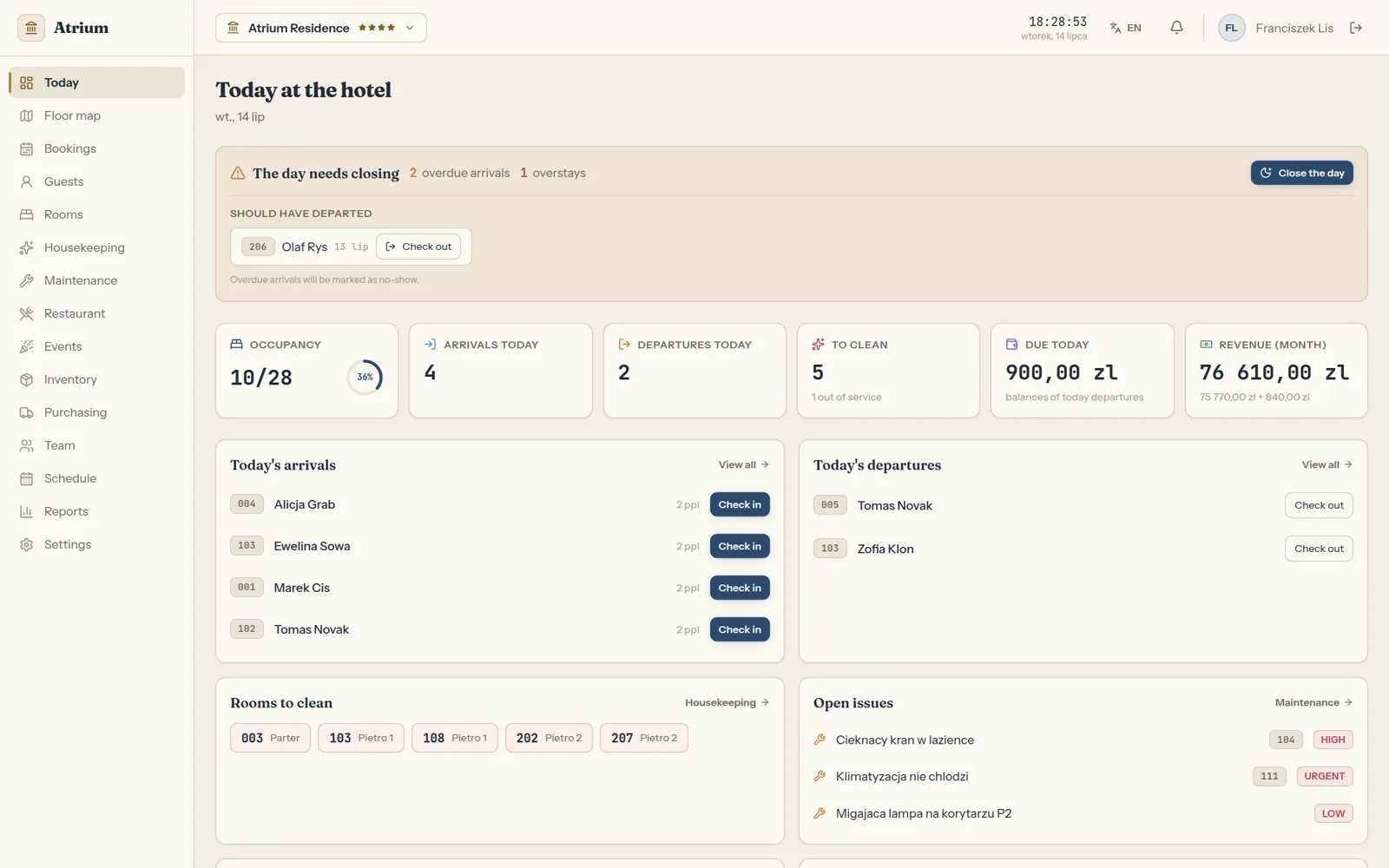
The "Today at the hotel" screen gathers everything the front desk lives on in the morning: occupancy, arrivals and departures with check-in and check-out buttons, rooms to clean with their floor, balances due from today's departures, revenue for the month and open issues with their priority. Nothing has to be looked for, because the day arranges itself into a to-do list.
At the end of the day the panel asks for the day to be closed. It shows guests who should already have left and arrivals that never happened, and closing marks the missing arrivals as no-shows. The day does not hang open until morning, and reports are computed from data someone deliberately confirmed.
Bookings on a timeline
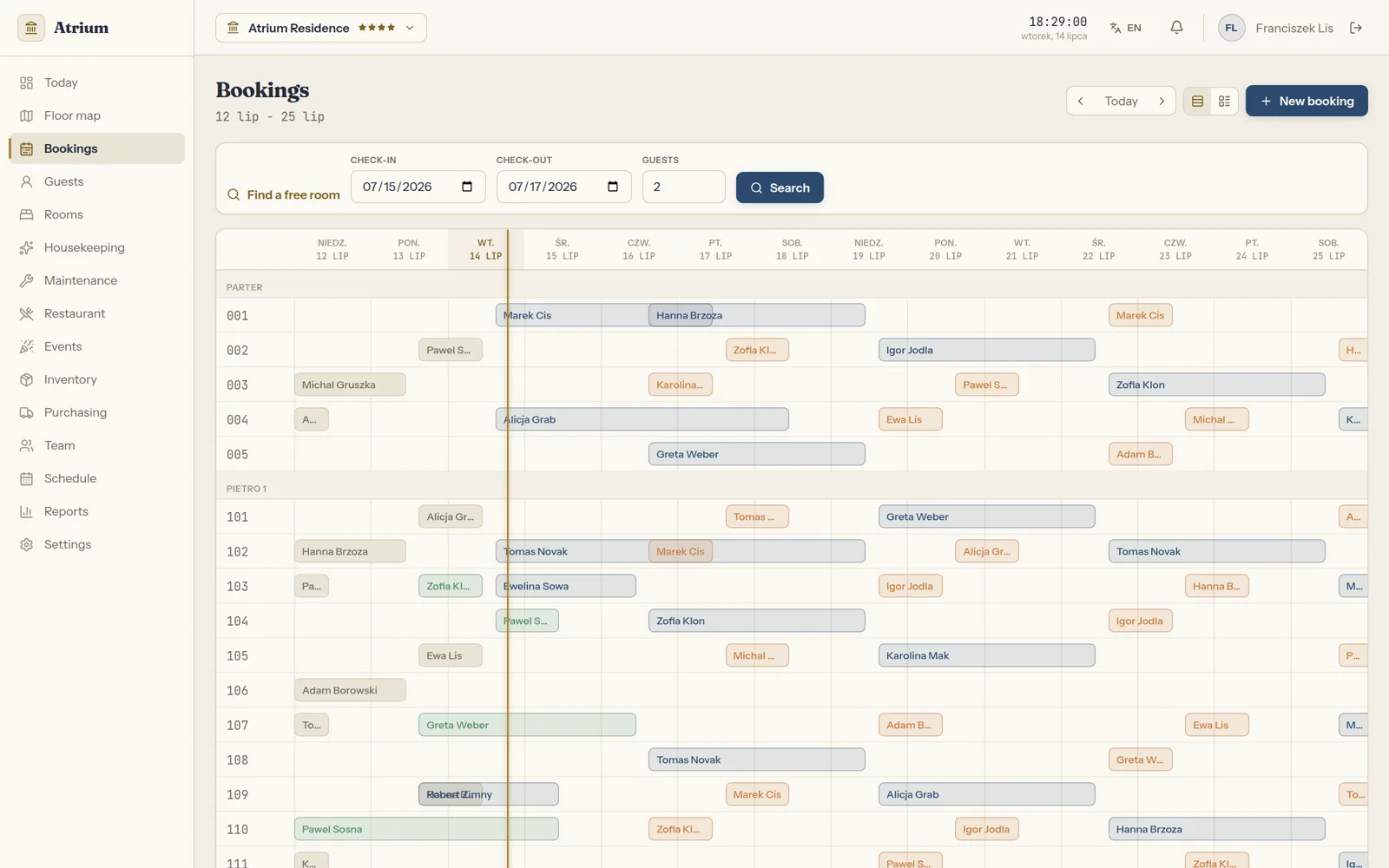
Bookings are laid out on a timeline of days, room by room and floor by floor. A double click on a room's row creates a booking starting that day, and the free-room search matches a room to the dates and the number of guests. The nightly price comes from the seasons set for the room type, and when no season covers a night, the base price applies.
The most important rule is no clashes. Before a booking is saved, the backend checks that the room is not taken at that time and that no planned or ongoing renovation blocks it.
Two ranges overlap when one starts before the other ends and ends after the other starts. The same condition guards bookings and renovations, so a room under renovation is simply not free. The front desk can save a booking despite a clash, but only deliberately, after a separate confirmation.
Housekeeping, repairs and renovations
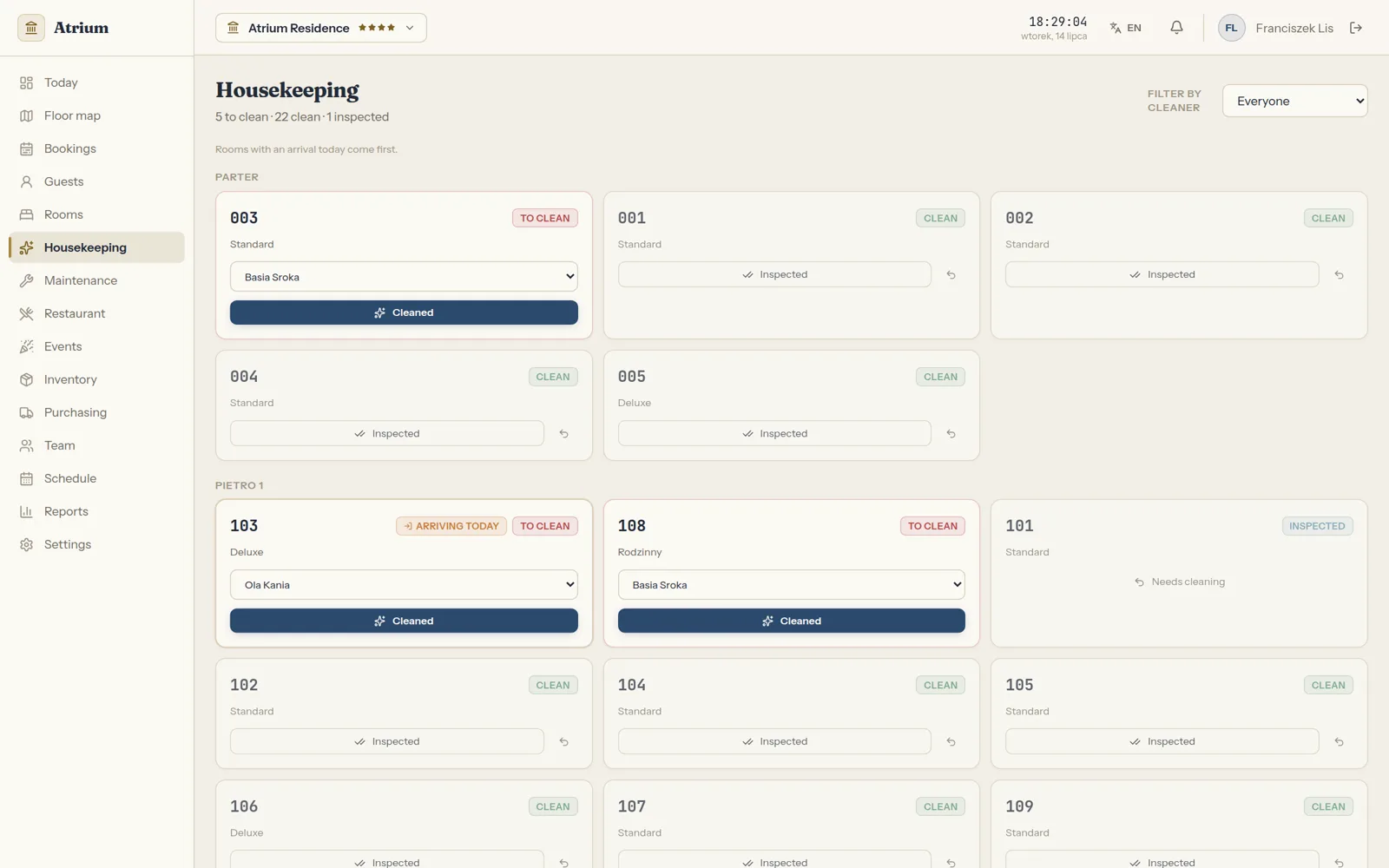
After check-out a room lands in the housekeeping queue by itself. Rooms with an arrival today go first, every room gets an assigned cleaner who marks it as cleaned, and then someone inspects it. The room's status shows up at once on the dashboard and on the floor map, so the front desk knows whether it can hand over the key.
A repair has a room, a priority and a cost that flows into the reports. A renovation is a separate thing: it has dates and blocks the room's bookings for that time, so nobody sells a room that is being repainted.
The restaurant, room service and the room bill
The restaurant has a menu with categories in Atrium, and orders that appear on the service board by themselves, without a refresh. A room-service order is added to the stay's bill, and at check-out the open orders are closed as paid together with the bill. Events, from weddings to conferences and tastings, have their own calendar in the same panel.
The guest gets a portal that needs no account: a link through which they send requests to the staff, from extra towels to a broken air conditioner, and follow the replies. Every request reaches the team as a thread with a category. The hotel can also run a referral program for guests, with rewards recorded in a ledger when the referred guest checks out.
Stock, suppliers and the rota
Inventory holds stock levels, thresholds and the supplier base. A purchase order is created in the panel, and receiving the delivery updates stock by itself, so nobody copies a wholesaler's invoice into a spreadsheet. The rota lays out the team's shifts, takes time-off requests for approval and estimates labour cost from hourly rates.
Reports show revenue, occupancy, ADR and RevPAR, seasonal rates and the share of returning guests. Every action in the panel stays in the hotel's activity log, everyone sets their own notifications category by category, and the owner can download all of the hotel's data in a single JSON file.
What the finished product actually delivers
The front desk starts the day on one screen and ends it by closing the day, and in between it does not switch between a notebook, a spreadsheet and a booking program. A room with an arrival today is cleaned first, a renovation never clashes with a booking, and a room-service order lands on the bill by itself.
The owner sees the hotel as it is right now, not as it was at the last report. Every number on the screen comes from the same records the team works on, and every change has a person and a time in the log.
Questions about Atrium hotel panel

More projects
More work from the same category - see how we tackle similar challenges.
Have a similar project?
Get in touch - a quote is free and comes back within an hour.