
Flaem client panel
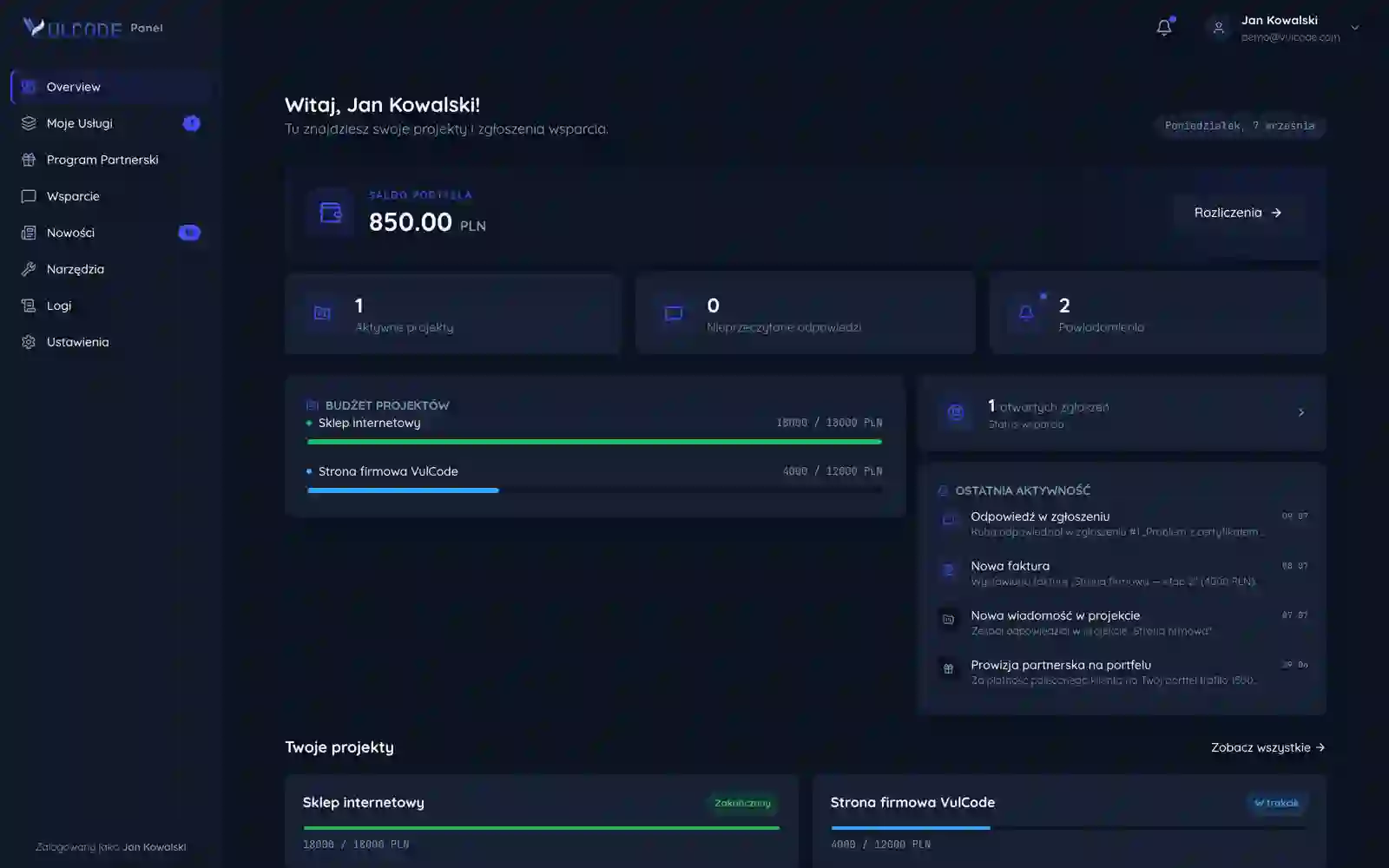
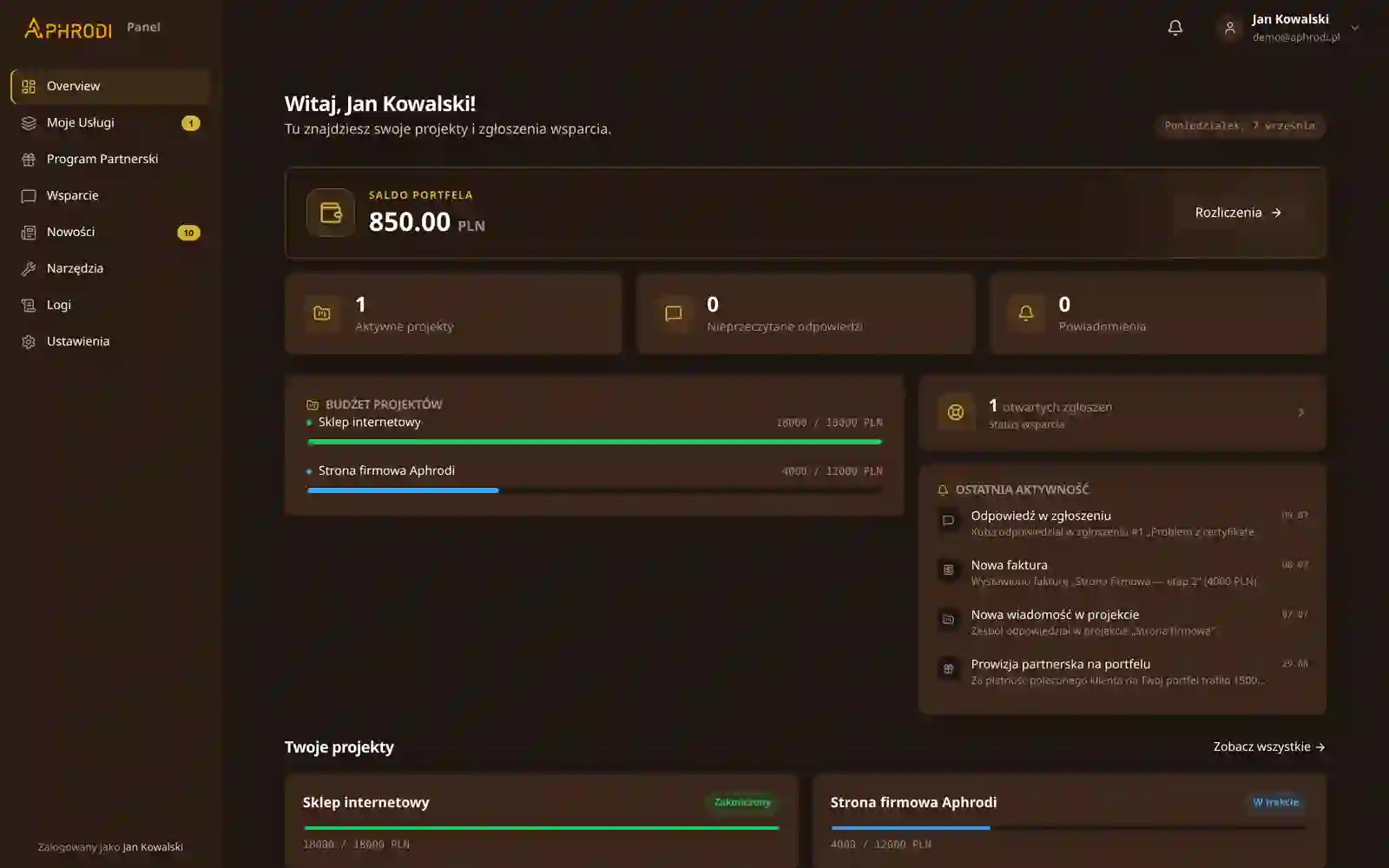
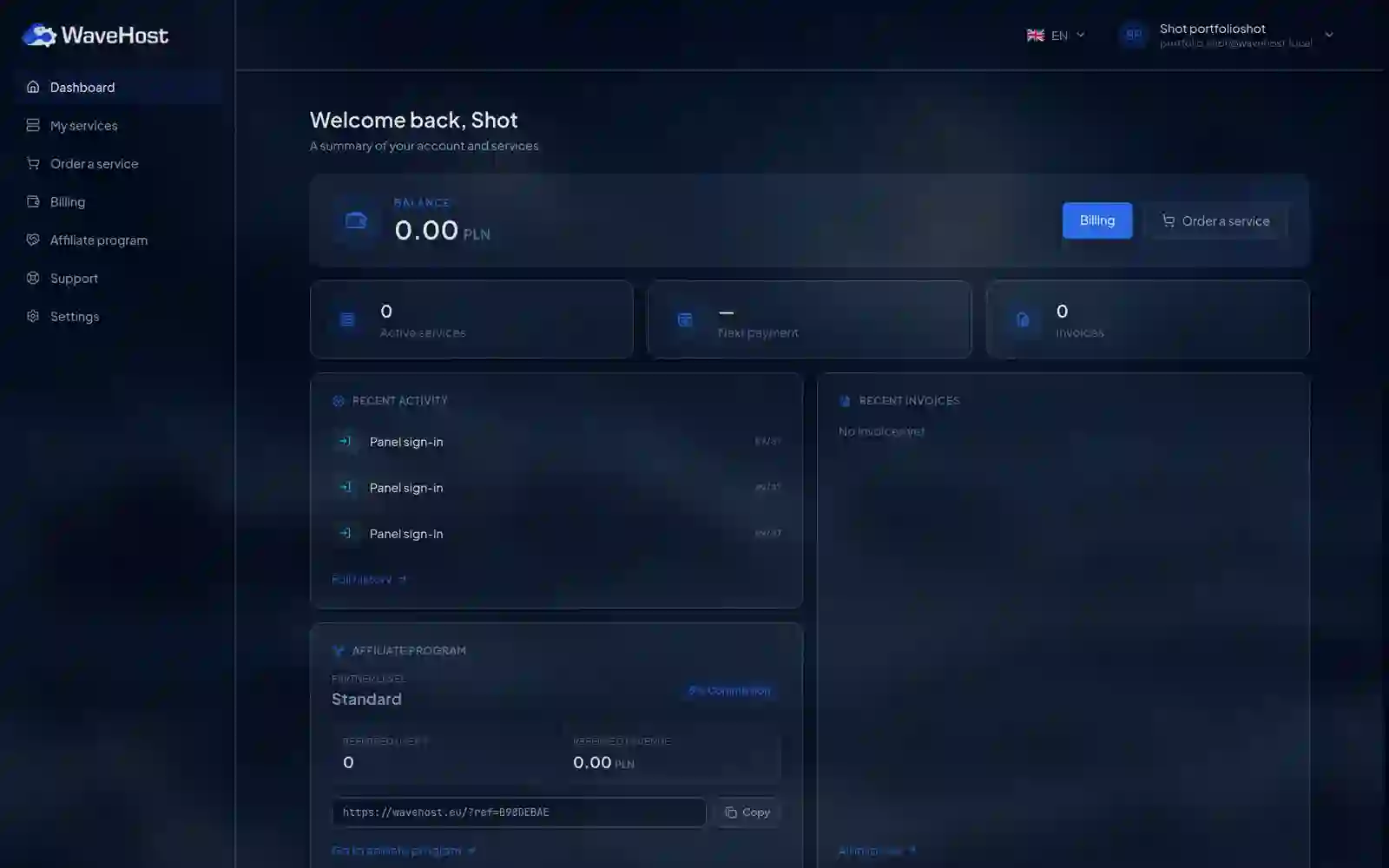
The panel where a hosting company's client buys and runs their own services: game servers with a live console, files and backups, VPSs, websites, domains and mail. The wallet, invoices, referrals, tickets and security settings sit in the same place, and charts show usage second by second. The panel wears the brand of the operator or reseller whose domain the client came in through.
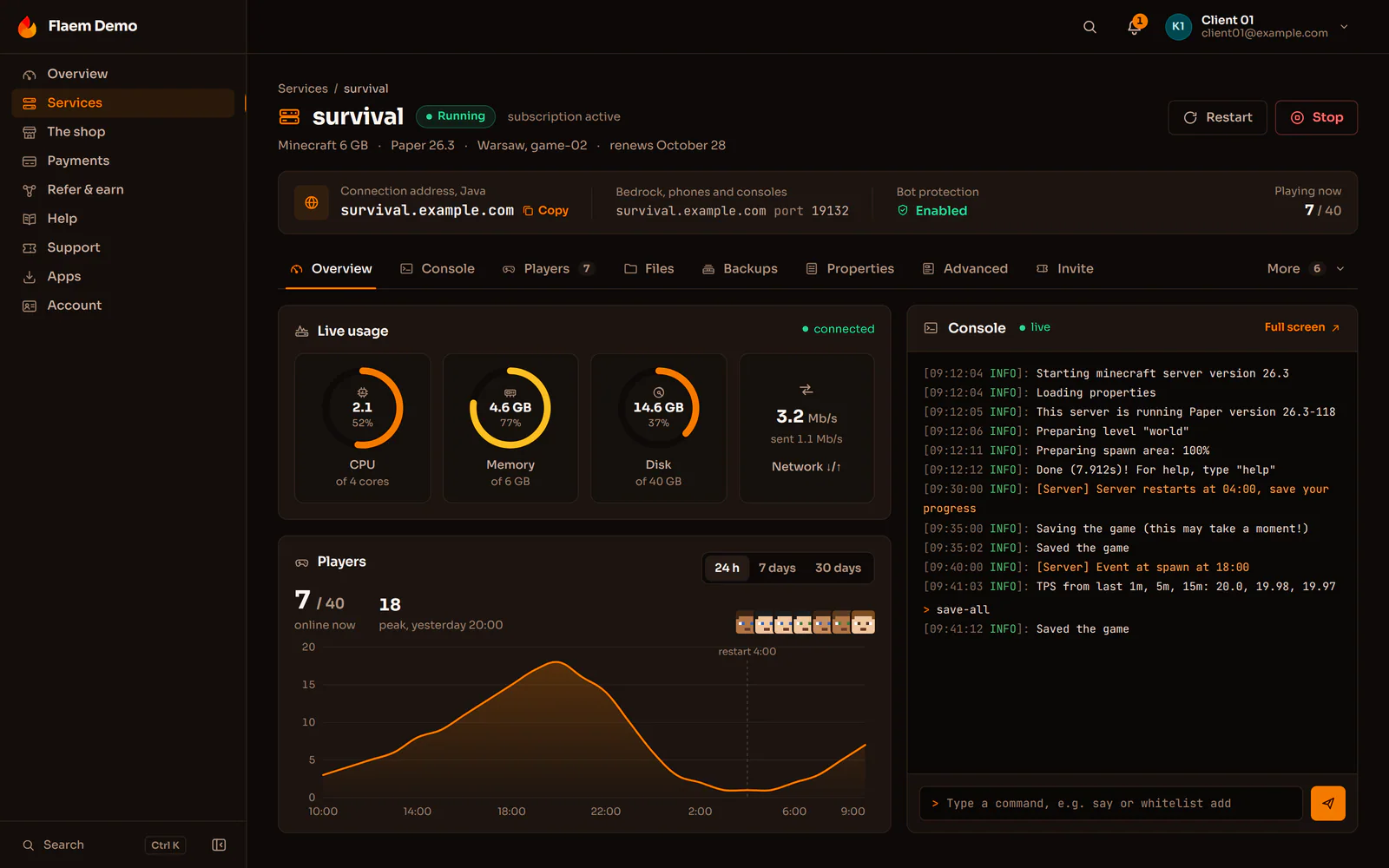
Overview
This is the part of Flaem a hosting company's clients see: the place where they buy a game server, a VPS, a website, a domain or mail and manage it right away. The client does not need to know Flaem is underneath. They see the brand of the operator or reseller they bought from, with its logo, colors and domain.
We designed the panel for people who are not administrators. The owner of a Minecraft server does not want to read logs, they want to know why the server went down and how to fix it. So everything that usually takes a support ticket has its own button here, and tickets are left for matters that genuinely cannot be handled alone.
A purchase that ends with a working service
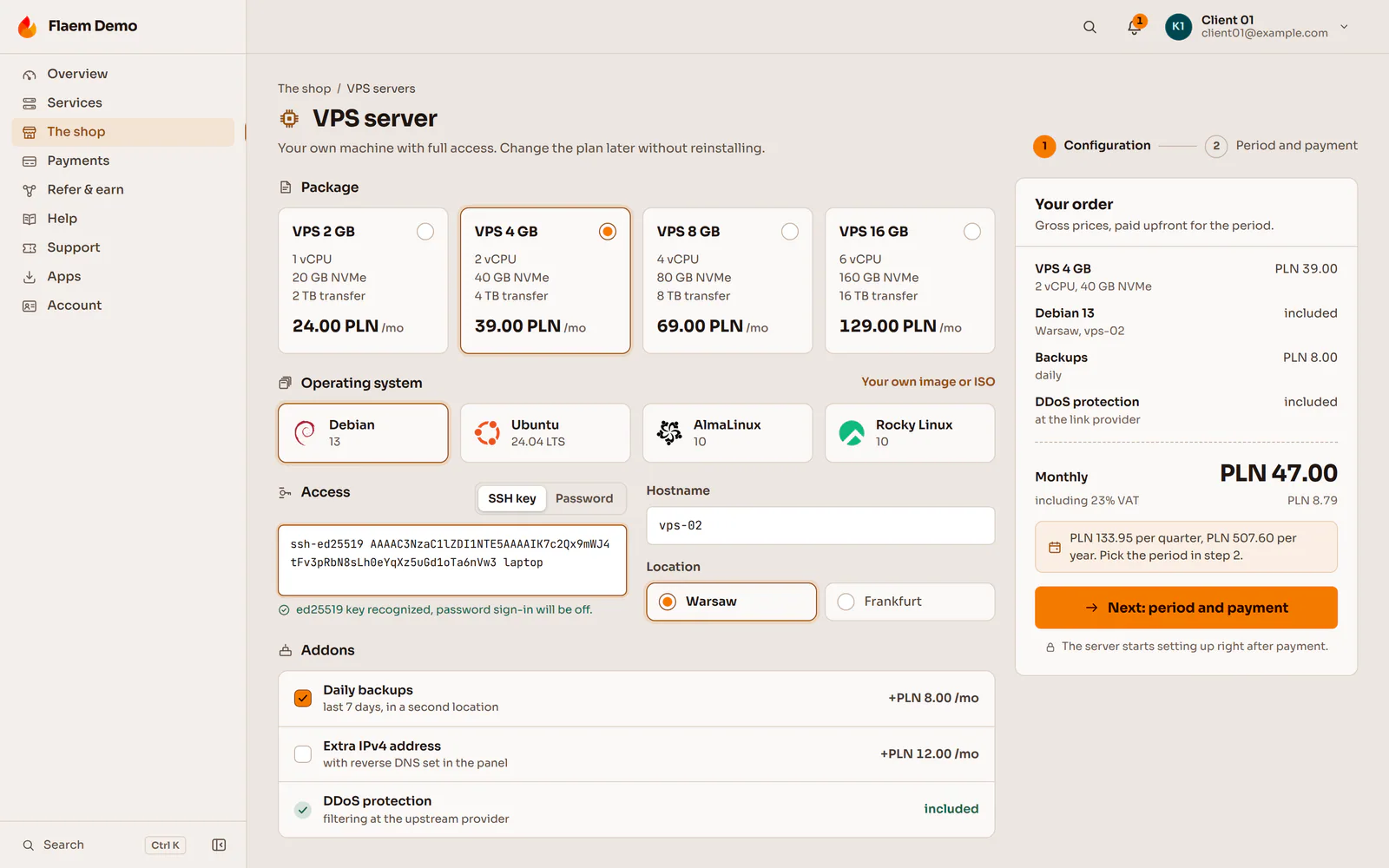
The store shows one offer per kind of service, for example Minecraft servers, with resource plans, and the client picks the engine, game version and add-ons in the cart. They see the amount to pay before paying, broken down into the plan, promotion, coupon, setup fee and add-ons, and it is the same amount that will appear on the invoice. A VPS is configured in one step: plan, system, SSH key or password, hostname, location and add-ons, with an order summary alongside.
After payment the service starts by itself and appears in the panel straight away. There is no email with credentials to copy over and no waiting for someone on the team to click "start".
A game server without writing to support
A game server has a live console in the panel, a file manager with an editor, SFTP access for larger batches of data, incremental backups and a restart schedule that counts down in the game chat first, so players have time to save their progress. The client installs mods and modpacks from catalogues, picks the game and Java version from a list, and sees startup settings as a form with descriptions instead of raw variables. On Minecraft they set world rules with switches and let in players from phones and consoles with a single toggle.
When the server goes down, the owner gets a plain-language sentence in their own language, a help article and a fix button, for example a Java version change or accepting the EULA. When they run short of resources, they see an offer of a bigger plan with the extra charge counted to the second for what is left of the period.
The extra charge is the price difference for the whole period multiplied by the fraction of seconds still left. The multiplication runs on 128-bit integers, so it cannot overflow on a long period, and rounding to the nearest minor unit works the same way in both directions: moving to a bigger and to a smaller plan is counted symmetrically.
Charts every second, with the peaks
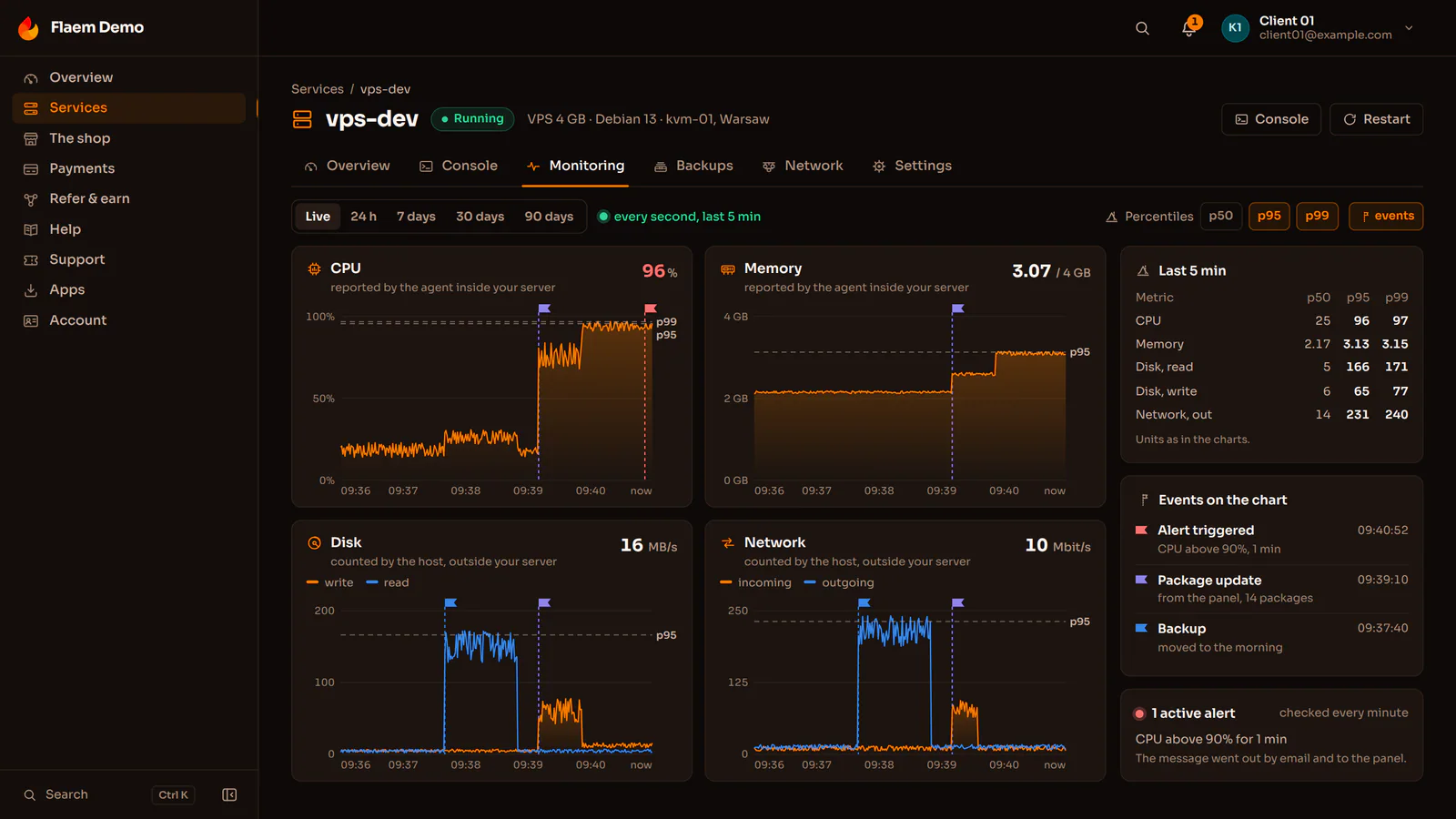
Every service is measured every second, and for each period the panel keeps the average, minimum, maximum and percentiles, so a short spike does not vanish in an average. The client sees their server's CPU, memory, disk and network, switches between the live view and recent days, and gets event markers on the timeline: a restart, an update, a backup, an alert. An alert about a crossed threshold arrives on the channels the client chose in their preferences: the panel, email, SMS, push, Telegram or Discord.
The client's money in one wallet
The client tops up the wallet whenever they like, with BLIK without leaving the panel, by card or by bank transfer, and every service takes its fee on its own renewal day if the client switched on renewal from the balance. Refunds, compensation and referral rewards go back to the wallet, and every movement has its own document. The client downloads invoices and corrections as PDFs. Before the due date they get a reminder, and without payment the service is suspended, not deleted, and comes back by itself once it is paid.
Players can chip in for a server in a shared pool. When the collected amount will not cover the next period, the people who contributed get a warning before the due date, not after it. The referral program gives the client a code, a link and a QR code, and rewards go to the wallet balance.
Support and an account under control
Before the client sends a ticket, the panel suggests articles that match what they are typing. Tickets and live chat sit in the same place, and the knowledge base works in all five panel languages. The staff member who replies sees the client's services and invoices next to the conversation, so they never ask about things the system already knows.
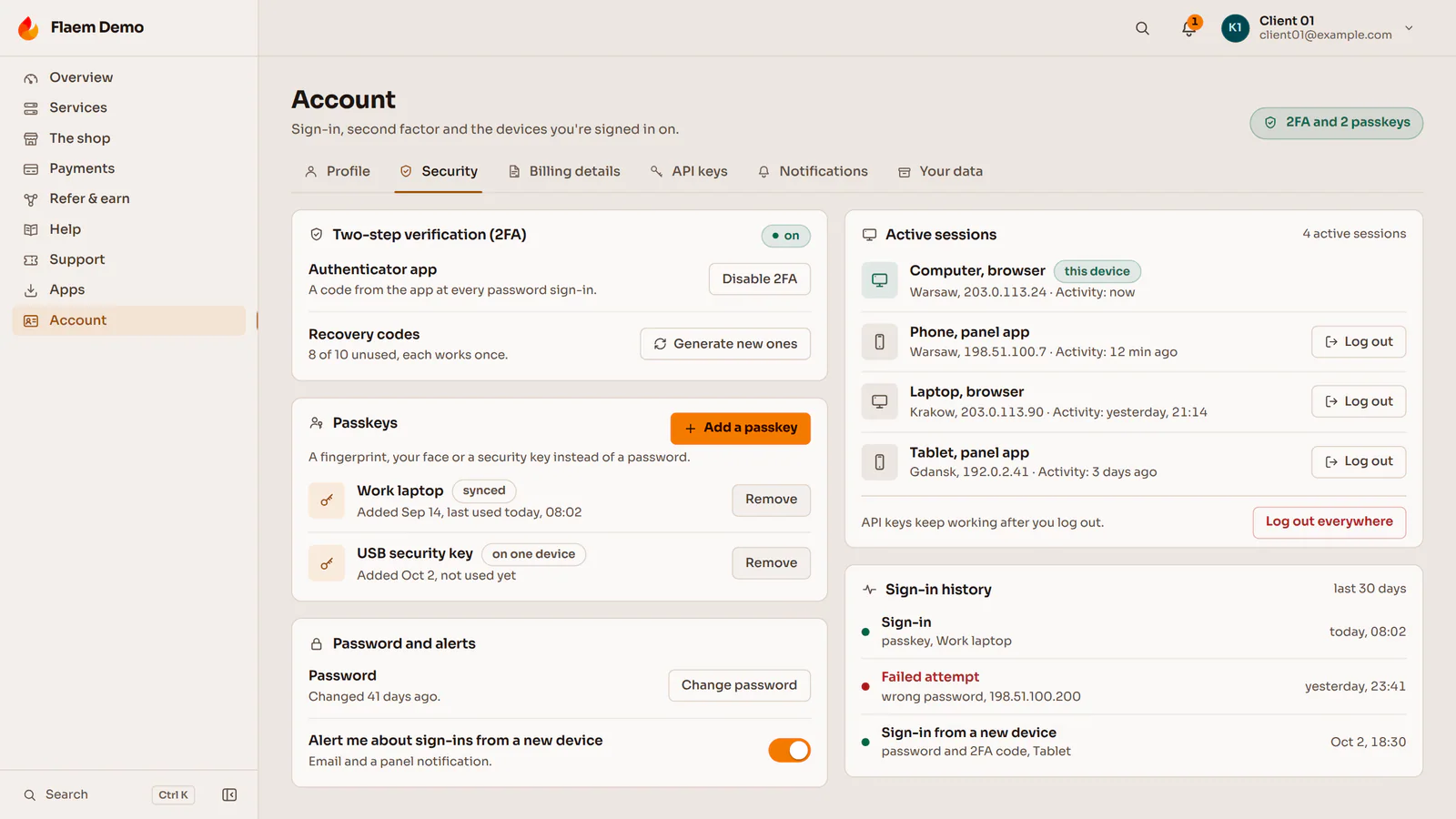
On their account the client has two-step verification, passkeys, recovery codes, a list of active sessions with sign-out everywhere, a login history, API keys, invoice details and an export of their data. The panel also works as an app on the phone, with the brand's name and icon and push notifications.
What the finished product actually delivers
The client buys a service and runs it straight away: restarts it, installs mods, restores a backup, changes the plan, pays and downloads the invoice, and when something breaks they know what happened and what to click. They write to support when they genuinely need a human, and the ticket arrives with their services and invoices already next to it.
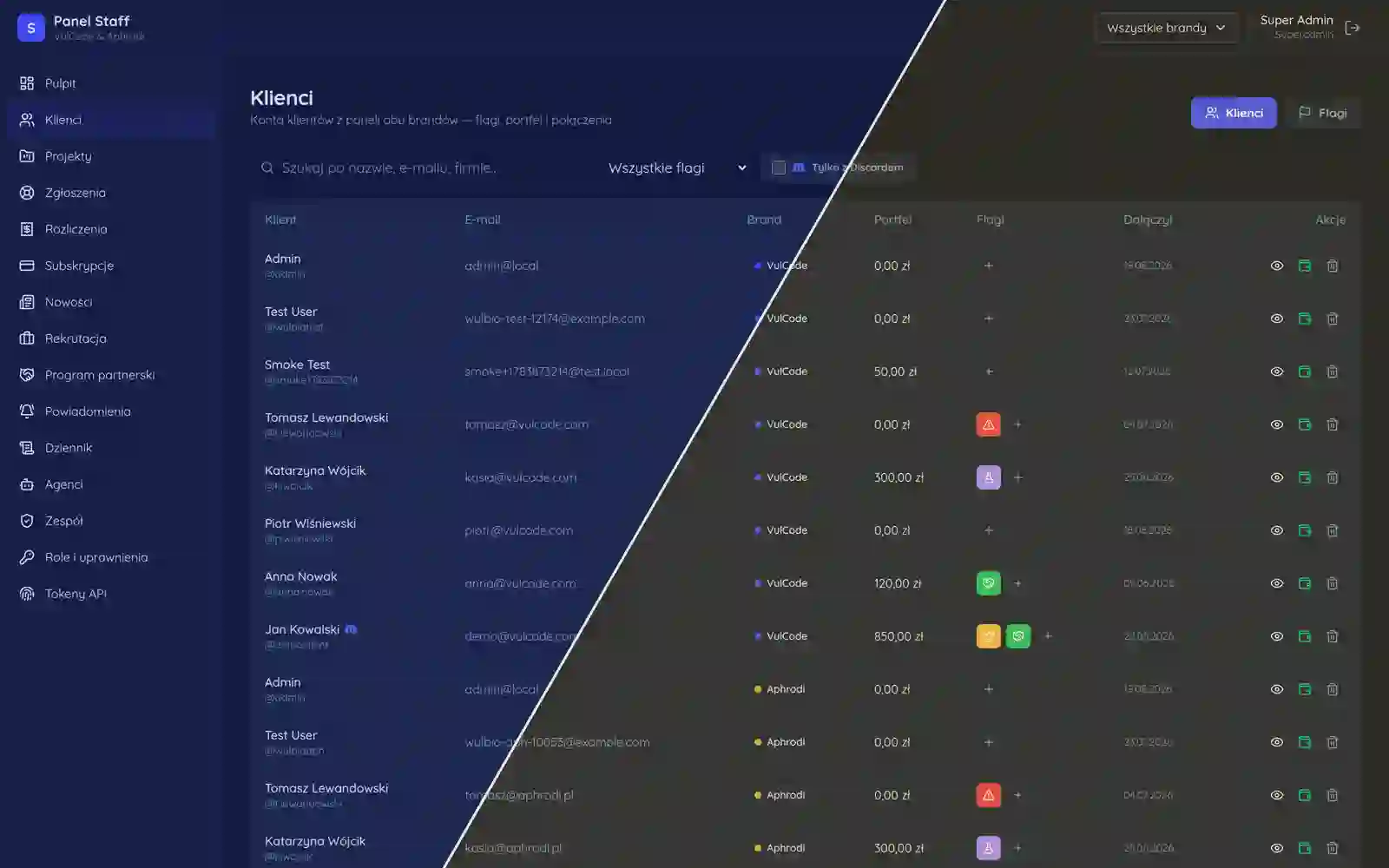
The hosting company gets a panel that looks like its own product, in its colors and under its domain, and that takes repetitive questions off the team. Every number the client sees, from the balance to the chart, comes from the same system that bills the service and controls it.
Questions about Flaem client panel

More projects
More work from the same category - see how we tackle similar challenges.
Have a similar project?
Get in touch - a quote is free and comes back within an hour.