
Flaem reseller panel
The panel where a reseller sells the operator's servers under their own brand: logo, domain, colors, pricing with a margin, invoices under their own tax ID and their own ticket desk. The panel will not save a price below wholesale, and every sale and renewal adds the margin to the reseller's ledger, from which they withdraw it. Permissions end at their own clients, so they never reach the operator's nodes or other resellers.
Overview
A reseller buys services from the operator at a wholesale price and sells them to their own clients under their own name. For the operator it is an extra sales channel without extra nodes, for the reseller a hosting business without their own infrastructure. For that to work, the reseller needs a panel that looks like their product, and the operator needs certainty that the panel will not let anyone do something that hurts them or other resellers.
The reseller panel in Flaem is a separate area of the same installation: the same nodes, the same store and the same billing system, but with the reseller's brand, prices, invoices and support. A reseller's client never sees that someone else is underneath.
A brand that follows the client
The reseller sets the look themselves, in an editor with a live preview of the panel next to it: the logo with the name and the bare mark, the tab icon, the login image, the accent color, the hover effect, the typeface and the default theme. From one color the panel works out the hover shade and the button glow by itself, and every field has a strictly defined shape, so a mistyped color cannot break the panel for the reseller's clients. Custom CSS applies only to the panel's pages, in a separate style layer with a size limit.
The panel recognises the brand by the domain the client comes in through. That lets one installation serve the operator's brand and every reseller's brand at the same time, while the client, from sign-up through the store, the invoice and the emails to support and the apps, sees only one: the one they bought from.
Where the client sees the reseller's brand
| Place | What belongs to the reseller |
|---|---|
| Sign-up and login | logo, colors, typeface and login image under their panel domain |
| Store and order | plans, prices, coupons and promotions |
| Invoice | seller details, numbering series, tax ID and KSeF token |
| Emails | header and footer in the brand's colors, text from their templates |
| Support | ticket desk, knowledge base and support contact |
| Apps | the brand's name and icon, links to phone and desktop versions |
A price never below wholesale
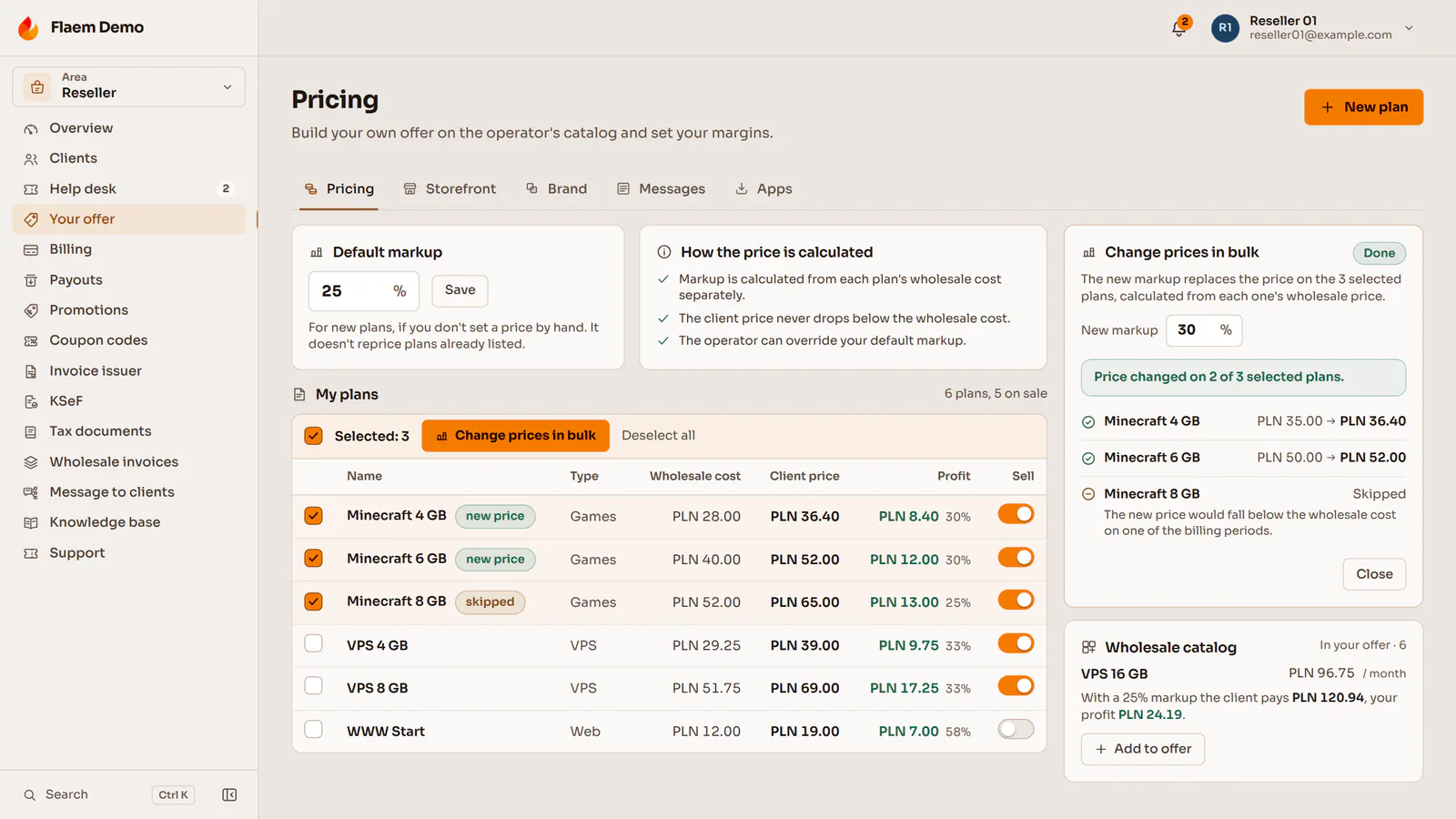
The reseller builds their plans on the operator's wholesale plans and sets their own price for every billing period. The panel will not save a price below wholesale on any enabled period, and prices of many plans change in one action, with a preview of what will change and what will be skipped. An operator promotion lowers only the reseller's cost, so the whole discount grows their margin. A reseller promotion comes out of their own margin and leaves the wholesale price untouched.
The most interesting case is when the operator later raises the wholesale price above the reseller's price. The margin then drops to zero, never below, the reseller never pays for their own sale, and they get a notification about the shortfall. That rule lives in one pure function that is easy to test without a database.
Amounts are whole integers in minor units, and both prices are converted into the currency of the reseller's wallet before the subtraction, with no exchange markup. Exchange-rate differences therefore never eat the profit quietly, and a conversion between two ledgers of the same operator never invents money out of nothing.
Two sales, two invoices
A sale through a reseller is two separate transactions: the client buys from the reseller, and the reseller buys from the operator. The reseller invoices their clients under their own tax ID, with their own numbering series and corrections, and their own token sends those invoices to KSeF in the context of their number, not through the operator's account.
The operator issues the reseller one wholesale invoice for each month, with a line for every sale, renewal and plan change, and every line is recorded exactly once. The same sale gives the same margin wherever the client lives, because the VAT rate changes the document, not the split of the money.
The margin in a ledger, and the payout
Every sale, renewal and plan change adds the margin to the reseller's ledger. A refund to the client reverses it with the same kind of entry, only negative, so the balance is always already reduced by what had to be given back, and the next wholesale invoice already accounts for it.
the margin lands in the reseller's ledger as an entry with an amount and the balance after it.
fresh money waits as many days as the operator set, and the panel shows when it frees up.
the reseller files a request, and the operator approves or rejects it.
the reseller keeps the margin for services with the operator, and that choice takes effect at once.
The server computes the reseller's results from that same ledger, not the browser from lists on the screen: sales and margin after refunds, monthly revenue, services and clients, overdue documents and the best-selling plans. Every currency is counted separately, because the panel does not add zloty to euro at a rate nobody chose.
The reseller's clients and nothing more
A reseller account has permissions trimmed to their own offer. The reseller runs their clients from purchase to cancellation: suspends and restores accounts, sends a password-setup link, tops up, renews, changes plans and messages all their clients at once. They can open a read-only view of a client's account for a limited time and with a log entry, and the client sees a notice about it. They never learn the client's password.
Nodes, instance settings, staff accounts and other resellers' clients are out of their reach. A question about another reseller's client gets the same answer as a question about a client that does not exist, so the panel does not even reveal that such a client exists.
The reseller's clients write tickets to the reseller's desk. When the provider's help is needed, the reseller hands the case to the operator with a note, and both answer in the same conversation, with no new ticket on the client's side. The reseller also has their own knowledge base, message templates in every panel language and the ratings their clients left after tickets.
What the finished product actually delivers
The reseller gets their own hosting business under their own brand: a panel, a store, invoices, emails, support and apps with their logo, plus results and margin payouts without a spreadsheet to reconcile. The operator gets a sales channel that cannot hurt them or other resellers, because the price cannot fall below wholesale, the margin cannot fall below zero, and permissions end at the reseller's own clients.
Both sides work on the same numbers. The same sale gives the same margin on the list, in the ledger, on the wholesale invoice and in the payout, because all of those screens read one record instead of each computing it its own way.
Questions about Flaem reseller panel

More projects
More work from the same category - see how we tackle similar challenges.
Have a similar project?
Get in touch - a quote is free and comes back within an hour.