
Shoper integration with wholesalers, ERP and Allegro
Wholesaler products reach your Shoper store by themselves, orders flow to Subiekt or another ERP, and stock matches Allegro. Through the Shoper REST API, within its limits.
Two routes into the Shoper API
Shoper distinguishes integrating one store from an app for many stores. Authorisation depends on it.
WebAPI user
One store's integration. We exchange the login and password of a user with WebAPI access for a token.
An app in the Shoper App Store
An app for many stores. Authorisation through OAuth with an authorisation code and a refresh token.
WebAPI user: A login and password for a token
A user with WebAPI access exchanges them for a token at /webapi/rest/auth. Without that access Shoper refuses authorisation.
An app in the Shoper App Store: An authorisation code and a refresh token
OAuth with grant_type authorization_code. A refresh token renews access, with no store login or password.
WebAPI user: You install it
You create the user in your store panel, with access to the resources it needs only.
An app in the Shoper App Store: Every store installs it
Every store that adds the app connects to it on its own.
WebAPI user: Wholesalers, ERP and couriers
It fits your store's integration with wholesalers, ERP and couriers.
An app in the Shoper App Store: A tool for other stores
We build one when the integration is meant for many stores.
The token and request limit in practice
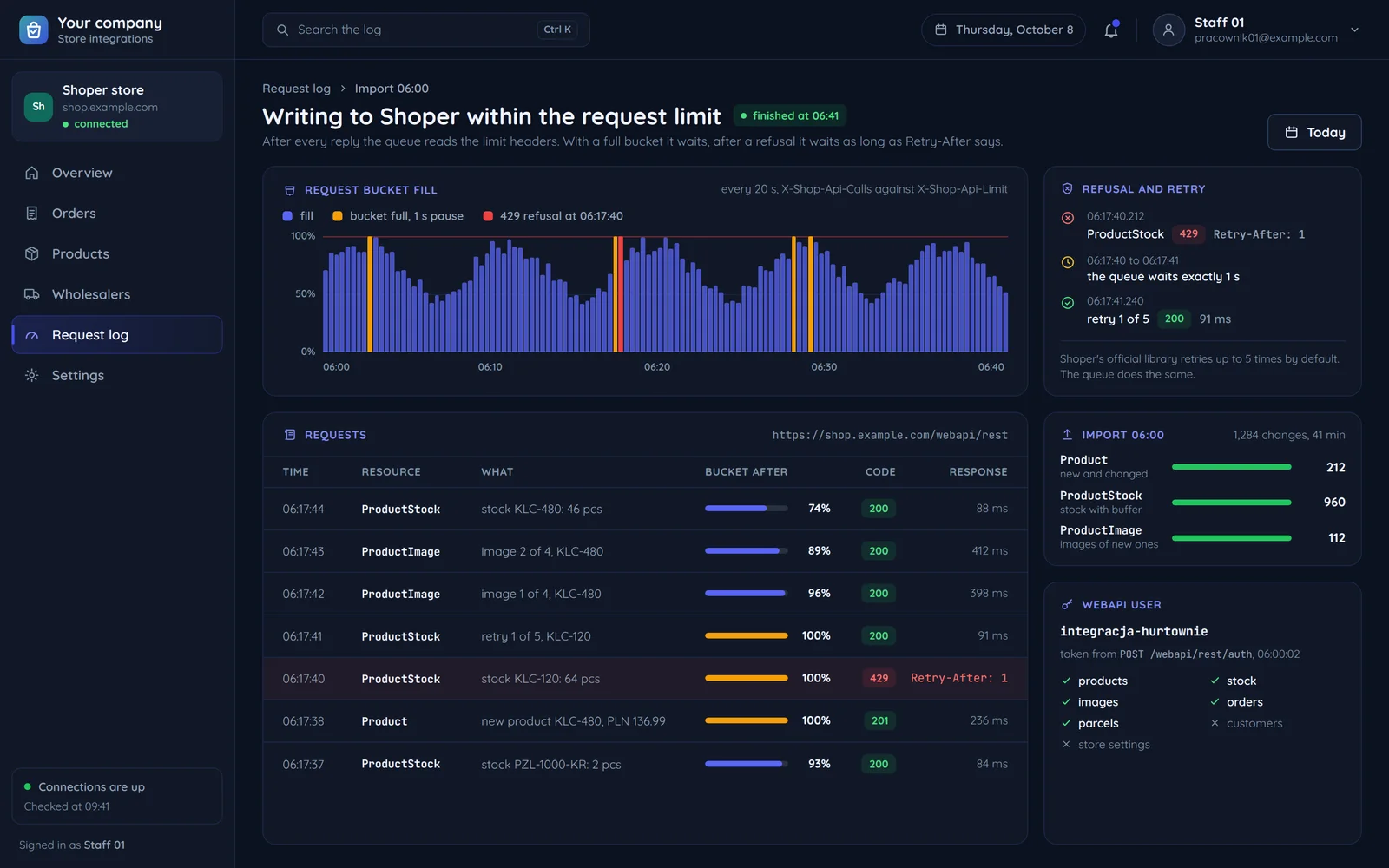
Shoper counts requests as a leaky bucket and says in headers how much is left. The import log shows how the queue uses that.
A wholesaler change
e.g. new stock or a priceA token for the WebAPI user
POST /webapi/rest/authThe integration's own account, with access to the resources it needs only, not an admin account.
A counter from headers
X-Shop-Api-Calls / X-Shop-Api-LimitHeaders say how many calls were used and what the limit is. With a full bucket the queue slows down.
A refusal and a retry
Retry-AfterOver the quota Shoper says in Retry-After how long to wait. The queue waits exactly that long and retries, like the official library, up to 5 times by default.
Written to the store
under the store address, at /webapi/rest
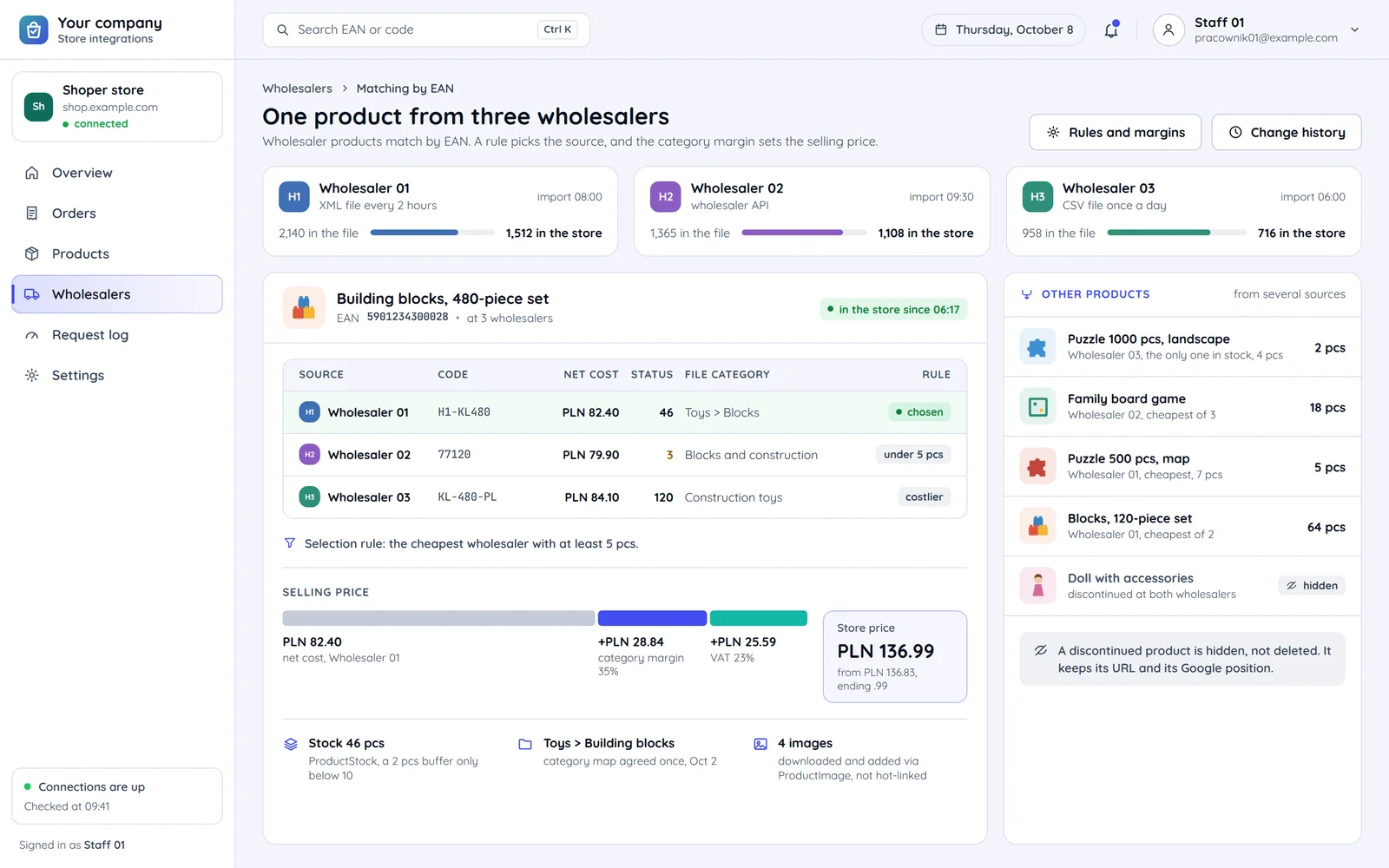
A wholesaler product in a Shoper store
The most common Shoper integration. The mapping decides whether customers see a clean listing or chaos.
The same product is in three wholesalers. The rule picked Wholesaler 01, the cheapest with at least 5 pieces.
A row of the Wholesaler 01 file
- Wholesaler code
- H1-KL480
- EAN
- 5901234300028
- Net purchase price
- PLN 82.40
- Wholesaler stock
- 46 pcs
- Category in the file
- Toys > Blocks
A shared key
- Store product
- KLC-480, the same EAN
Product code and EAN with no duplicates. When one EAN has several wholesalers, the rule picks one.
Margin and VAT
- After a 35% margin
- PLN 111.24 net
- With 23% VAT
- PLN 136.83
- With the price ending
- PLN 136.99
The category margin, the VAT rate and the price ending by your rules.
Stock and category
- Store stock
- 46 pcs, no buffer at this level
- Store category
- Toys > Building blocks
A stock buffer at low quantities, the category from a map agreed once.
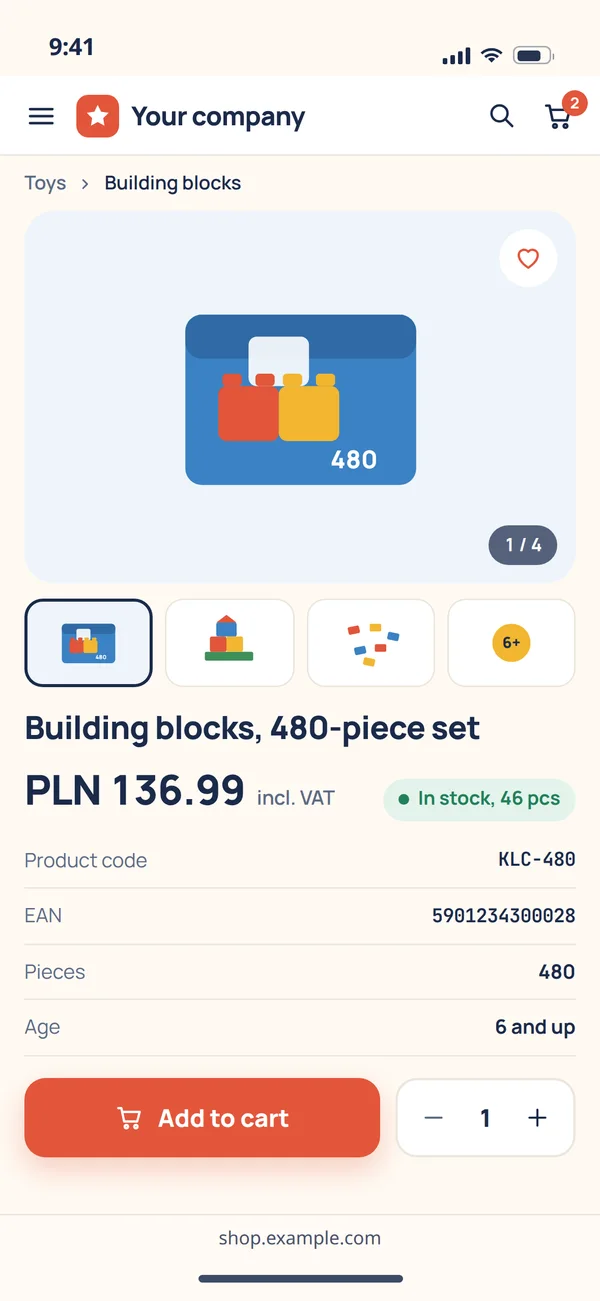
The product on Shoper
- PLN 136.99 with VAT
- Available, 46 pcs
- 4 images downloaded and added through the API, not hot-linked
What flows between Shoper and the back office
Each direction has its own resource in the Shoper REST API.
- Orders and their lines
OrderOrderProductA webhook or polling the Order and OrderProduct resources. - Products and images
ProductProductImageA new file or a wholesaler API change. - Stock
ProductStockAn ERP document or an Allegro sale, with a buffer at low quantities. - Parcels
ParcelA parcel dispatched with a courier, with the tracking number. - Order statusA change in the store or the ERP.
What we watch out for with Shoper
What decides whether the integration survives a big catalogue.
A separate WebAPI user
The integration gets its own account with access to the resources it needs only, not an admin account.
A request counter from headers
A big import fills the bucket fast. The queue reads the headers and slows down before Shoper refuses.
Hiding instead of deleting
A deleted product leaves a dead URL. A hidden one keeps its URL and Google position.
Redirects on changes
Shoper has a redirect resource in its API, so a product URL change can get a redirect straight away.
Common questions about Shoper
Answers about ready apps, imports, migration and the quote.

Read next
Other platforms and store integrations.
Where does your Shoper store get its goods?
Tell us which wholesalers and ERP you use. We will reply within an hour with questions and a quote.