
Taking over a software project from another vendor
We take over projects left half-finished or run by a team you no longer work with. We start with a code review and a quote for what is left, and finish with a working release and the documentation that was missing.
When to take a project over
A project takeover means finishing an app or site another team started, without rewriting everything when there is no need to. For companies whose project stalled halfway, where giving up would cost more than finishing.
Diagnosis first
The quote comes after a code review, not blind.
Secrets first
We rotate passwords, keys and tokens the previous contractor may have known before we change anything.
A test version
You can check each stage before it reaches production.
Documentation at the end
Setup, architecture and deployment written down for the next person.
What we take over
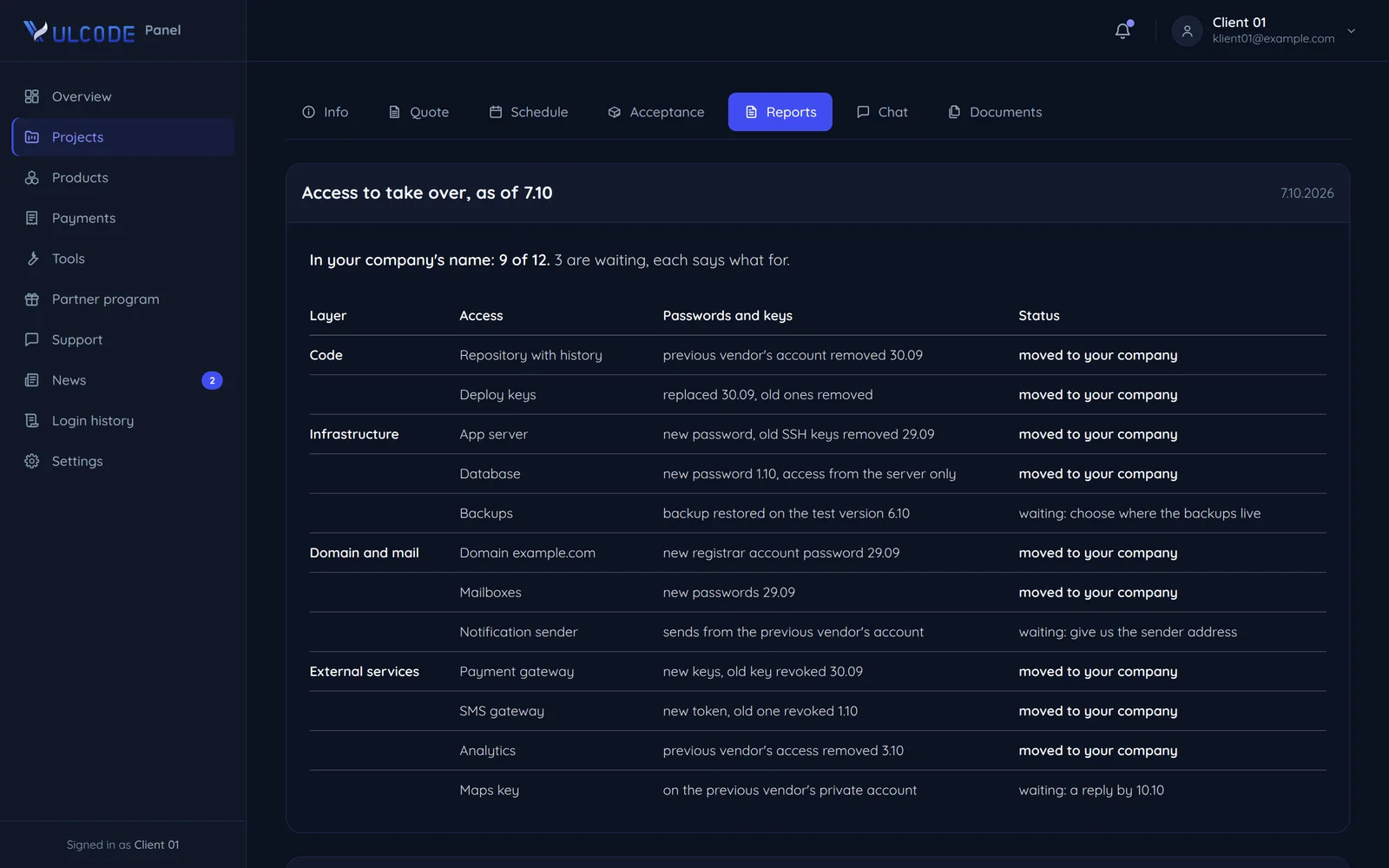
A project is more than code: each layer has its own access and goes through the same three steps before we count it as taken over. The drawing shows an example halfway through.
You recover an account in your company's name from the registrar or provider as its owner, and we tell you what to ask for. A key that lived only on the previous vendor's private account is set up again on your company's account.
What each step means
Repository
- New passwords and keys: the previous vendor's account removed, deploy keys replaced.
- In your company's name: the repository, with its full history, on your company's account.
- In the documentation: setup and deployment described in the repository itself.
Server and database
- New passwords and keys: new server and database passwords, old SSH keys removed.
- In your company's name: the server on your company's account with the provider.
- In the documentation: the backups and the deploy process written down.
Domain and mail
- New passwords and keys: a new password for the registrar account.
- In your company's name: the domain registered to your company.
- In the documentation: a list of the DNS records, mailboxes and mail senders.
External services
- New passwords and keys: gateway keys and API tokens issued again, the old ones revoked.
- In your company's name: the payment gateway, analytics and store accounts in your company's name.
- In the documentation: a list of the services and where their keys live.
What the review report looks like
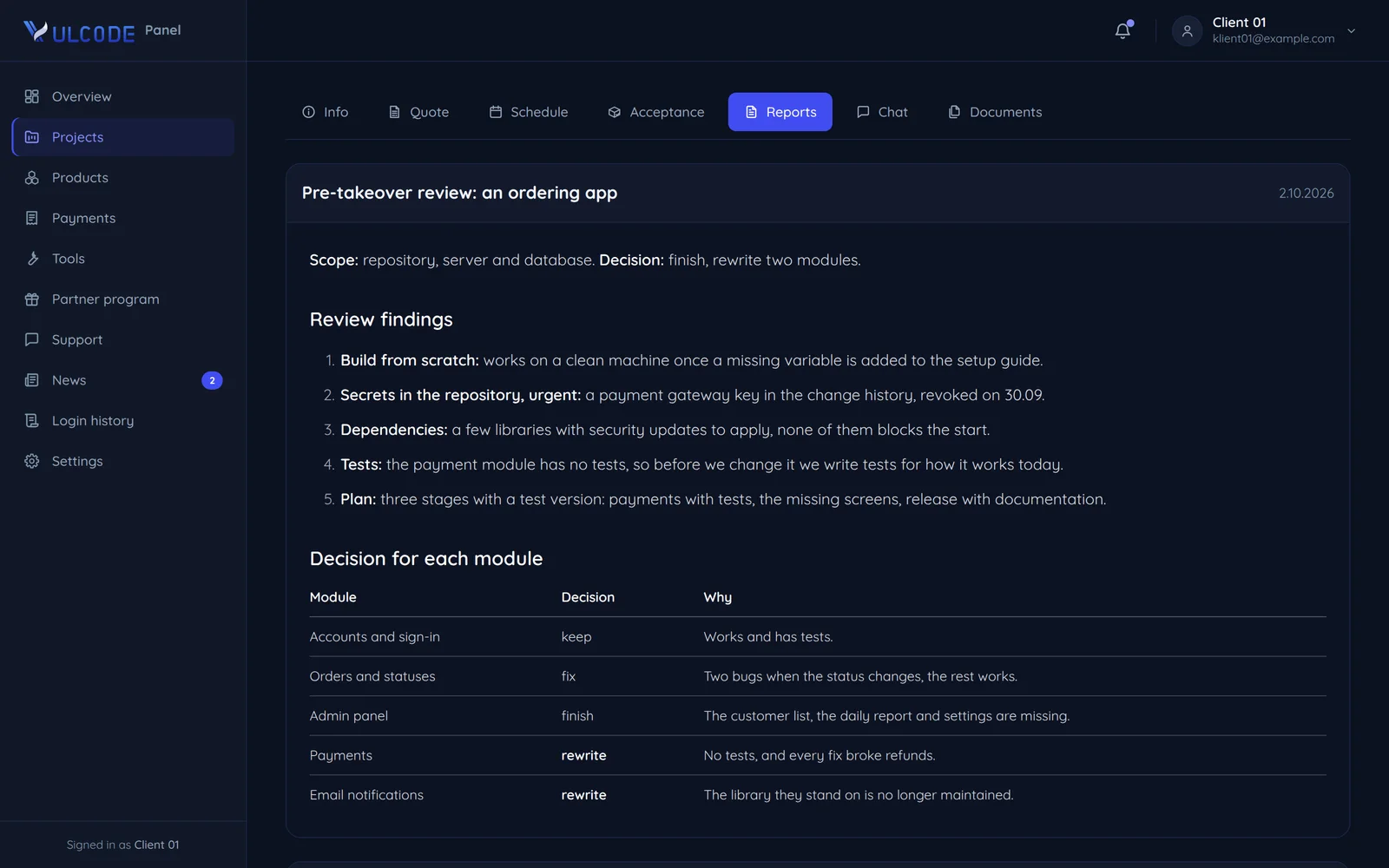
Before we promise anything, we check what is really in the repository. A sample, shortened review report for an ordering app.
The state of the repository
Whether the project builds and runs on a clean machine without the previous team's knowledge. Without it there is no point quoting further work.
Risks, most urgent first
A key in the repository history is revoked at once. Libraries with fixes to apply and modules without tests go into the work plan.
A recommendation for each module
Keep, fix, finish or rewrite, with the reason. We walk through the report on a call, and the decision is always yours.
Finish or rewrite
Finishing usually pays off. Not always. The choice is made module by module, not for the whole project.
Finish
- What works stays as it is.
- We fix what is broken or unfinished.
- We finish in stages on a test version.
Rewrite part of it
- We rewrite only the modules that need it.
- The rest of the app, if it is sound, stays as it is.
- The new module gets tests from the start.
The code builds, and the problems sit in individual modules
Outweighs: Finish. We fix those modules and finish the rest in stages, without a rewrite.
A module patched many times breaks with every change
Outweighs: Rewrite part of it. Patching would cost more than writing it again, with tests from the start.
The data and URLs work and have traffic
Outweighs: Finish. That traffic is not worth losing in a move, so we build on what is there.
The library a module stands on is no longer maintained
Outweighs: Rewrite part of it. It gets no more security fixes, so we rewrite that module and keep the rest.
How we take a project over
First we check what is in the code, only then do we quote the rest. An ordering app left by a freelancer who stopped replying.
We gather the repository, access to servers and services, and anything the previous team left behind, including written agreements.
We run the project on a clean machine and assess the code, dependencies and security.
Based on the review you get the scope split into stages, a date for each stage and risks named plainly.
We work in stages on a test version, and every change gets reviewed. You see progress as we go.
We release the project and document setup, architecture and deployment.
- Access to the code
We gather the repository, access to servers and services, and anything the previous team left behind, including written agreements.
you get: full access after rotated passwords - Review
We run the project on a clean machine and assess the code, dependencies and security.
Repository and serverpayment keys rotated the same dayyou get: a report: what to keep, what to rewrite - Quote for the rest
Based on the review you get the scope split into stages, a date for each stage and risks named plainly.
Missing screensthe second stage of workyou get: a plan with a quote - Finishing
We work in stages on a test version, and every change gets reviewed. You see progress as we go.
Payment modulerewritten first, with testsa change of scope goes back to the quote: Quote for the restyou get: stages accepted on the test version - Release and documentation
We release the project and document setup, architecture and deployment.
you get: a working project with documentation
Who does what in a takeover
Gathering access quickly saves the most time.
You
Backups: waiting on your choiceYou give access to the accounts held by your company and pass on the agreements with the previous vendor. You decide the scope and accept the stages.
Us
Payment gateway: new keys, the old one revokedWe rotate passwords and keys, do the review and the plan, finish the project on a test version and write the documentation. Passwords and code fall under the confidentiality duty in our terms, clause 9.1.
Previous vendor
Maps key: on the vendor's private accountThey hold the repository and any access not yet handed over, and knowledge nobody wrote down. When something is missing, we rebuild it with you.
Common questions about project takeovers
Answers about the cost, the state of the code, access and what happens after handover.

Read next
Pages that help before a takeover and after it.
Is your project stuck with a previous vendor?
Tell us what exists, what is missing and what you have access to. We will reply within an hour with questions and a quote for the review.