
A travel agency website with tour search and online booking
Tours with filters instead of a PDF catalogue, booking with a deposit and the documents the law requires before the contract, and language versions for travellers from abroad.
What slows down tour sales
Three places where an agency loses customers or hours of work.
Tours in a PDF or in social posts
- Today
Customers scroll a catalogue, cannot filter by dates or budget, and Google cannot see the itinerary.
- After launch
Each tour is a page with an itinerary, dates and price, and the list has filters: dates, transport, length and audience.
Enquiries by email and phone
- Today
Questions about free seats, replies with calculations, a separate email with documents and another with bank details.
- After launch
Free seats are shown next to each date, the booking collects travellers, and the deposit and documents run in one path.
Documents before the contract
- Today
The information form and terms are sent by hand, with no record of who got them.
- After launch
Documents are a booking step, acceptance is saved with a date, and a copy goes by email on a durable medium.
Booking with deposit and documents
The customer stays on your website and the agency gets complete data.
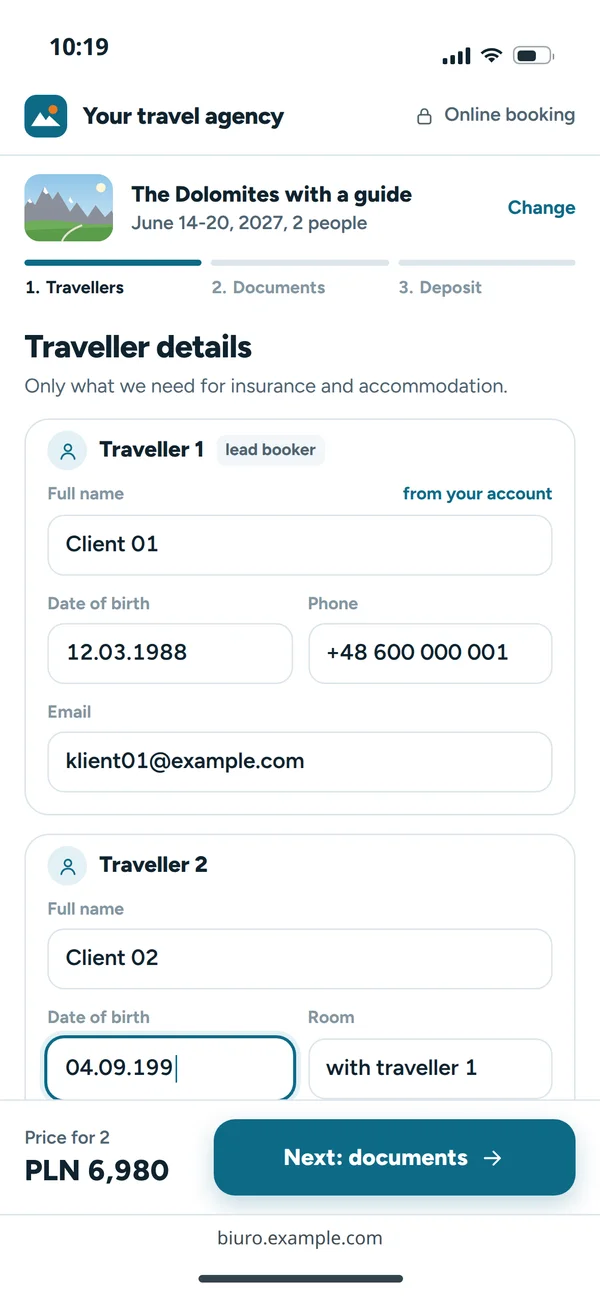
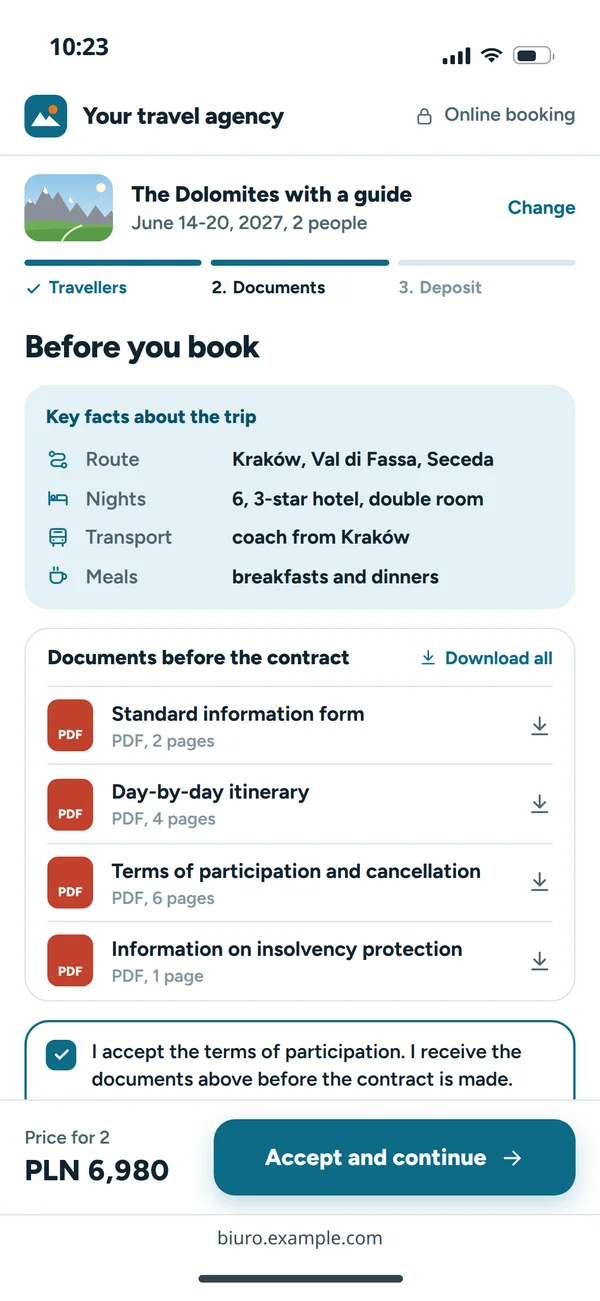
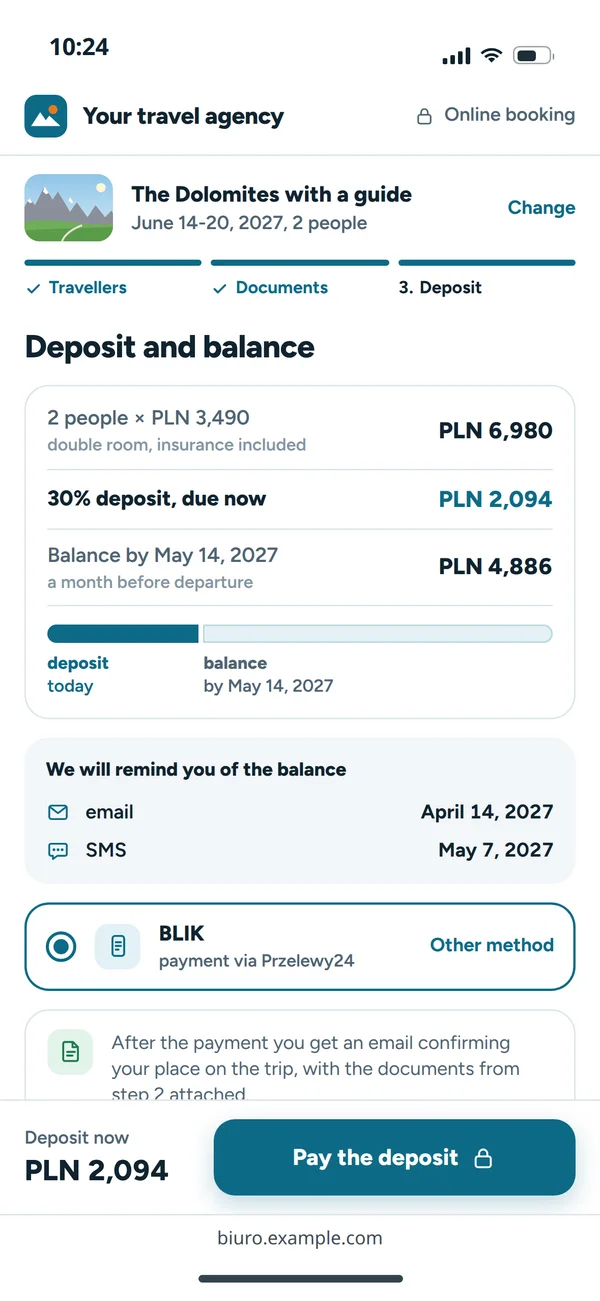
Booking in three steps after choosing a date
Travellers, documents and the deposit. The customer stays on your website and the agency gets complete data.
Travellers
Each person's details in the scope you need for insurance and accommodation. The form remembers the lead booker.
Behind the scenes: the agency gets complete data
Information before the contract
The standard information form, itinerary and booking terms as a required step before the customer pays.
Behind the scenes: the acceptance is saved with its date
Deposit and balance
A deposit through a payment operator, and the balance due date reminded automatically by email and SMS.
Behind the scenes: the confirmation is generated once the deposit is paid
The confirmation the customer gets after booking
One document with everything agreed, sent automatically. The numbers on the document match the notes beside it.
- Everything that was agreedDates, travellers and accommodation come from the booking, nobody re-types them.
- Payments with due datesThe deposit with its status from the payment operator and the balance date the system reminds about.
- Documents attachedWhat the customer accepted before paying also arrives as a file, which is a durable medium.
- Details for the tripInformation that changes at the last minute goes in a separate SMS on departure day.
- Tour
- The Dolomites with a guide
- Dates
- 14-20 June
- Travellers2 people
- Accommodationdouble room
- Deposit2,094 PLN, paid
- Balance4,886 PLN, by 14 Mayto schedule
- AttachmentsStandard information form, Itinerary and booking terms, Insolvency protection information
- Contact during the tripThe tour leader's and the agency's phone numbers by SMS on departure day.
Generated from the agency panel, a copy is kept in the booking history.
What happens to the booking next
- Deposit paid
the confirmation with its attachments goes out automatically
- Before the balance is due
a reminder by email and SMS
- Departure day
an SMS with the tour leader's and the agency's numbers
The agency panel: seats, payments and group enquiries
The integrations travel agencies ask for most often. Each can be added on its own. A link to a tour operator's booking system is possible if it offers an API. We check that before quoting.
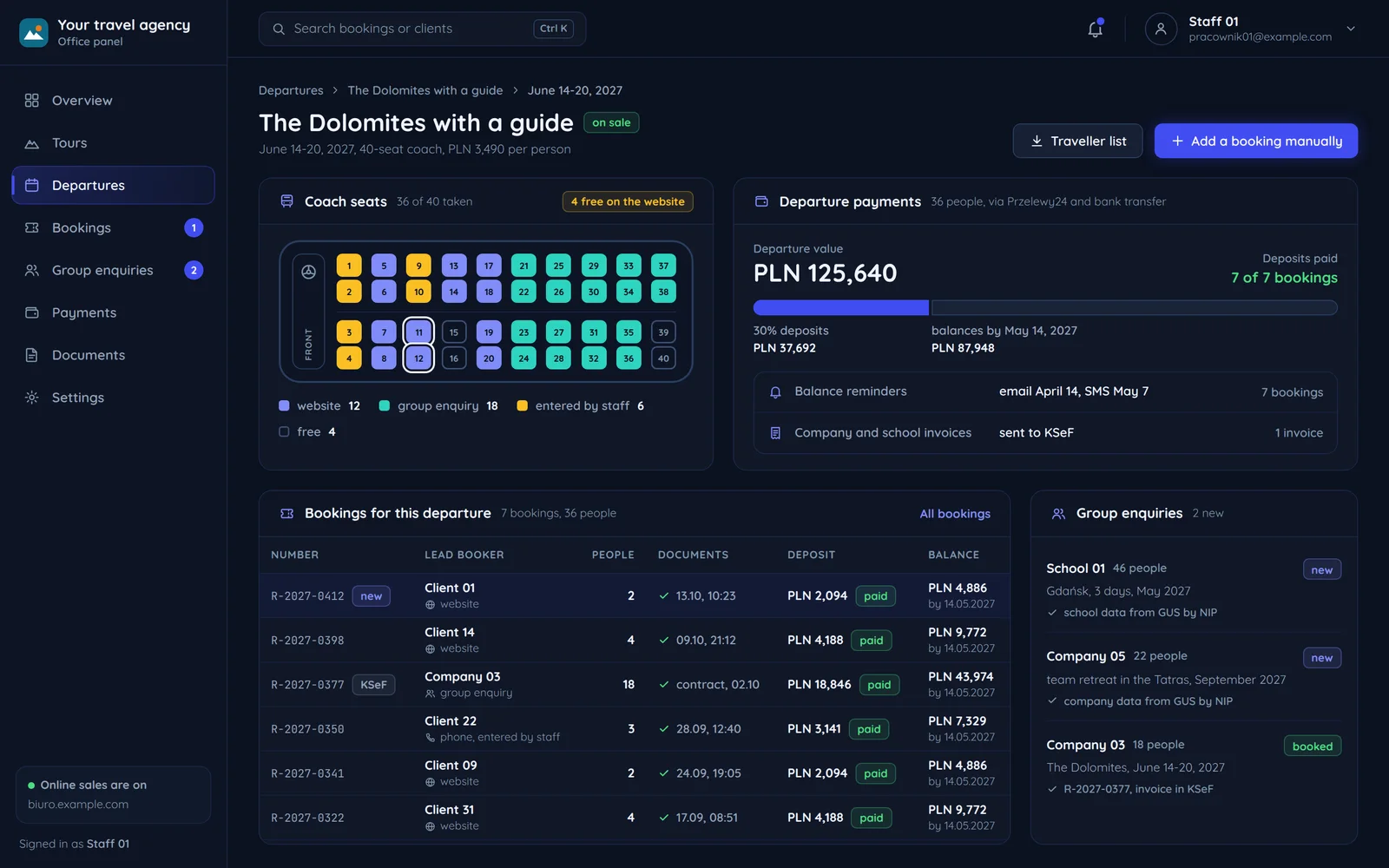
Free seats next to each date
From the agency panel: seats go down with each booking and staff enter manual corrections.
Przelewy24
Deposit and balance, refunds on cancellation, payment status in the booking. The system reminds about the balance due date by email and SMS on its own.
Group enquiries
For schools and companies there is an enquiry form with group size and dates instead of a cart, and it lands in the agency panel. Company or school details filled in from the tax ID in a group enquiry.
A tour operator's information duties in the booking path
Poland's package travel act says what travellers must get before and after the contract. We build it into the form, not into separate emails. We write this as the website builder, not a law firm, so it is not legal advice.
The standard information form before the contract
The tour operator, and the agent selling the package, give the traveller standard information using the information form before the contract is signed (art. 39(1)).
Trip information before the traveller is bound
Destination, route, duration, number of nights, transport and the other items in art. 40(1) are on the tour page and in the acceptance step.
A copy of the contract or a confirmation on a durable medium
When the contract is concluded, or without undue delay after it, the traveller gets a copy or a confirmation (art. 42(2)). The document is generated after the deposit is paid.
Accessible online sales
Online sales to consumers must meet accessibility requirements since 28 June 2025, except for microenterprises (Dz.U. 2024 item 731).
Tour search instead of a catalogue
Individual travellers search by dates and budget, schools and companies by group size. The search handles both.
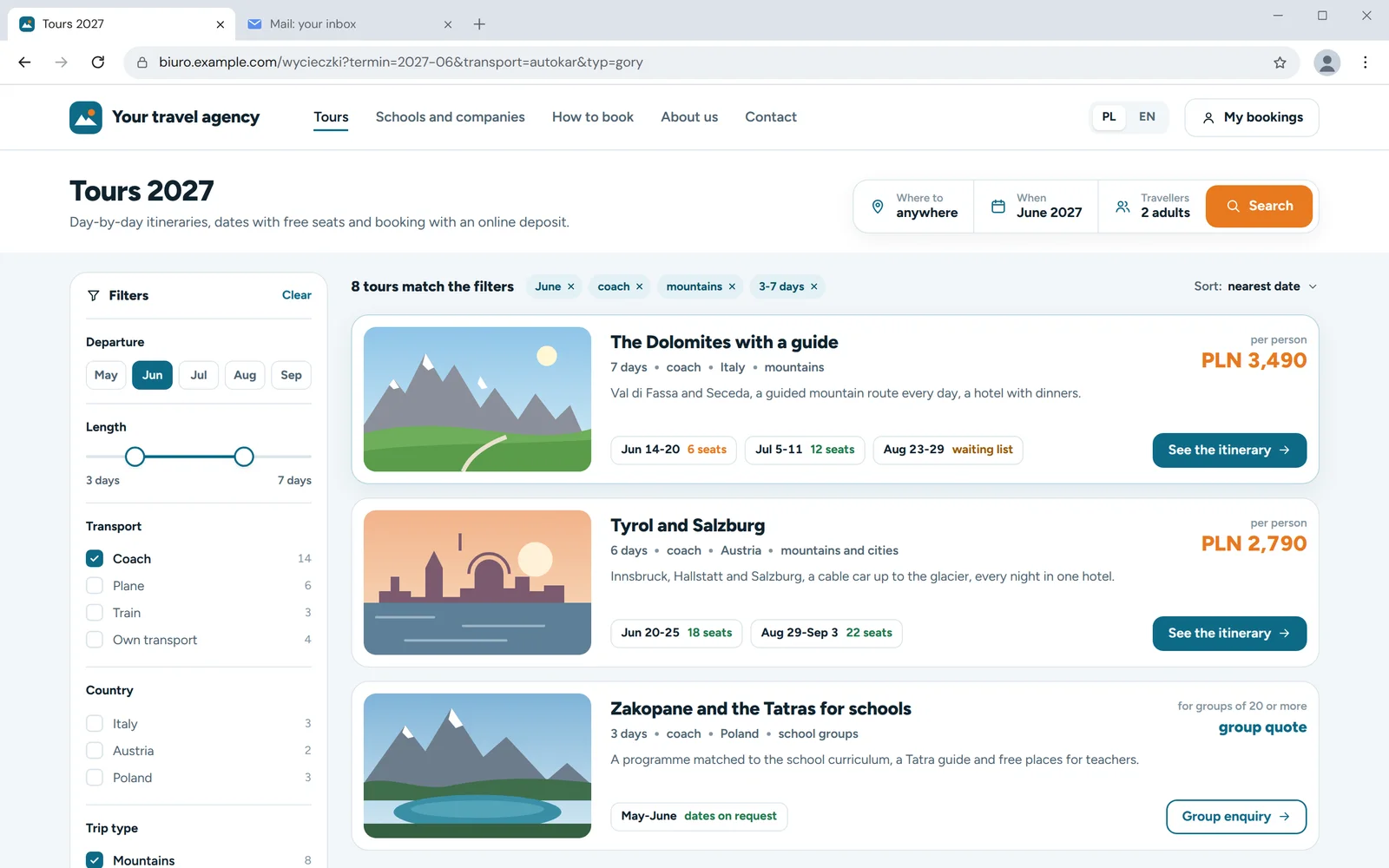
A travel agency website
Filters that fit your offer
Dates, length, transport, country, trip type and groups. The filters follow how you sell, not a template.Each tour on its own page
A day-by-day itinerary, accommodation, a price with what it includes and dates with free seats. Every page is its own chance in search.Language versions
Tours for international travellers in separate versions with hreflang, built as a multilingual website.
Questions travel agencies ask
The most common questions before moving sales to the website.

Read next
Transport and accommodation that often go with tours.
Let us move your catalogue to the website
Tell us how many tours you run and how you take bookings today. We will reply with a proposed scope and a free quote.