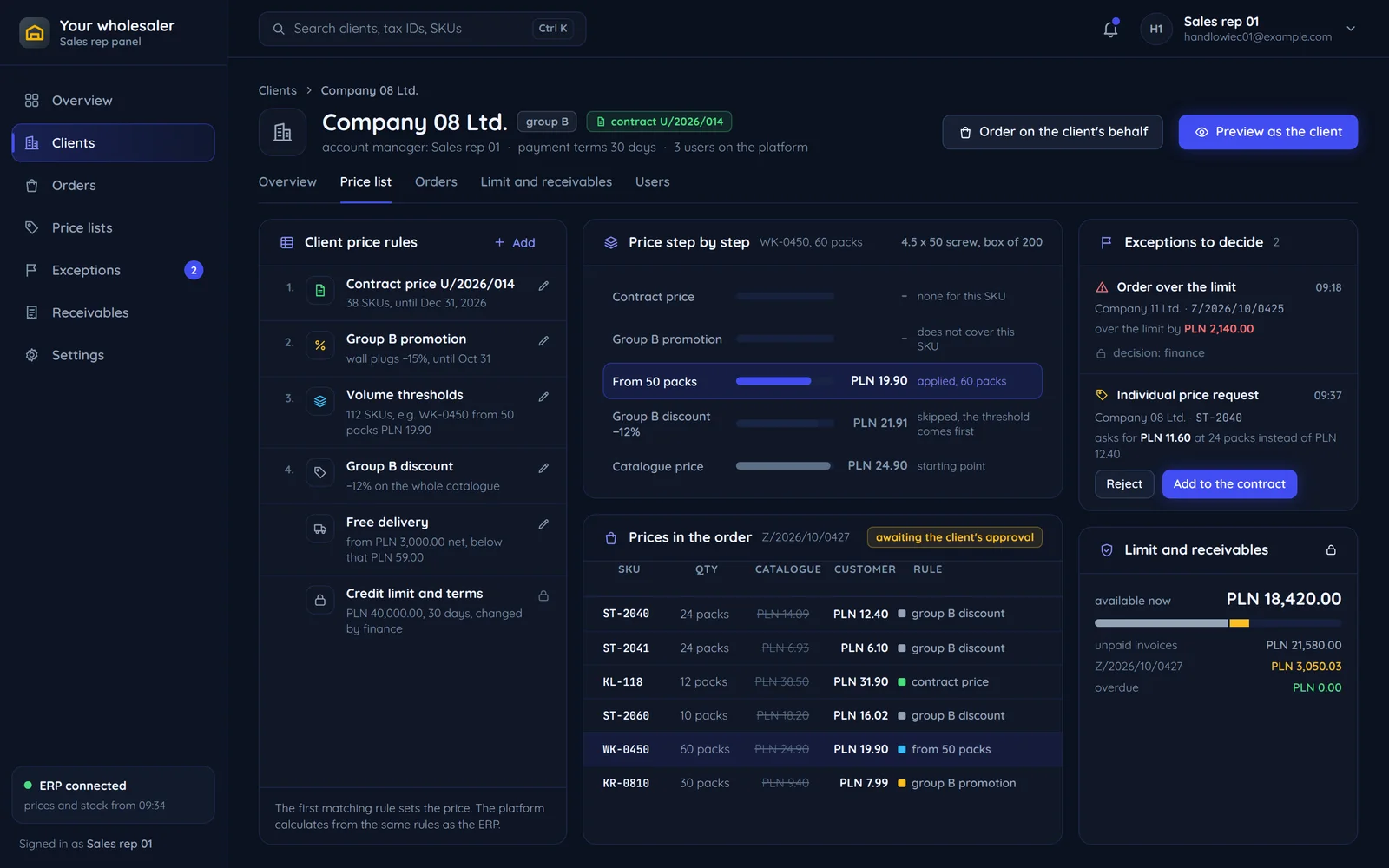

Under Poland's Act on Counteracting Excessive Delays in Commercial Transactions, a payment term between businesses may not exceed 60 days from delivery of the invoice, unless the parties expressly agree otherwise and the term is not grossly unfair to the creditor (Article 7(2)). When a large enterprise buys from a micro, small or medium one, 60 days is a hard ceiling (Article 7(2a)). The platform keeps each client's term, from the ERP or its own settings.
What you set and what the client sees
| You set | The client sees |
|---|---|
| the client's price group | group prices across the catalogue |
| a quantity discount from a threshold | a unit price that drops with quantity |
| a contract price for chosen SKUs | their own price instead of the catalogue one |
| a credit limit and payment term | how much of the limit is left before they order |
The limit is checked on every order
Before an order reaches the ERP, the platform checks the credit limit, overdue receivables and the minimum order value. Orders over the limit wait for finance, and the sales rep only sees those exceptions. At the client's end a buyer places the order and a manager approves it. The invoice goes to KSeF, Poland's e-invoicing system, while its copy, the delivery note and order statuses wait in the client's account, so nobody emails for paperwork from three months ago. The ERP, from Subiekt GT and Comarch Optima to enova365 and Symfonia, stays the source of truth for prices and stock.
Interest on late payments is covered in our late payment interest post, and the platform on our B2B solutions page.
Was this post helpful?